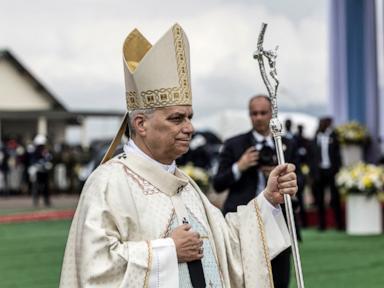
The media is having a collective meltdown because Pope Leo—the man currently holding the keys to the most influential spiritual real estate on the planet—just told the political world to take a hike. The headlines are screaming about "missed opportunities" and "cowardice." They claim he’s dodging a fight. They argue that in an era of radical transparency, everyone is entitled to a podium, especially when a former President and current firebrand like Donald Trump is standing on the other side.
They are wrong. Dead wrong.
The lazy consensus suggests that every conflict deserves a stage. It assumes that "debate" is a neutral tool for truth-seeking. In reality, a debate between a religious sovereign and a populist politician isn't an exchange of ideas; it’s a deliberate devaluation of the Papacy's brand equity. Pope Leo isn't running from a fight. He is executing a clinical exercise in asymmetric power preservation.
The Fallacy of the "Open Forum"
When the press asks why Leo won't step into the ring, they are operating under the delusion that all voices are equal in a digital vacuum. They aren't. In the world of high-stakes negotiation and global influence, the person who sets the terms of engagement wins before a single word is spoken.
By saying it is "not in his interest" to debate, Leo is signaling that his authority does not derive from public opinion polls or the 24-hour news cycle. Trump’s power is built on the Attention Economy. He wins by being in the room, by sucking the oxygen out of the air, and by forcing his opponent to play by his rules of engagement. For a Pope, whose authority is rooted in centuries of tradition and a claim to divine mandate, stepping onto a debate stage is a demotion.
Think about it like this: You don't see the CEO of a Trillion-dollar conglomerate debating a disgruntled shareholder on a street corner. Not because they can't win the argument, but because the act of arguing validates the shareholder's parity.
The Logic of Selective Silence
In my years analyzing institutional risk, I’ve seen leaders flush their credibility down the drain by trying to be "accessible." They mistake visibility for impact. They think that if they just explain their side one more time, the opposition will suddenly find clarity.
It never happens.
Every time a high-level official engages in a "battle of wits" with a professional disruptor, they lose. If they win the argument, they look like a bully. If they lose, they look like a fraud. If it’s a draw, the disruptor gets to claim they are on the same level as the establishment.
Leo knows the math.
- Risk: Alienating 50% of the global flock regardless of what is said.
- Reward: A temporary bump in Twitter mentions that lasts 48 hours.
- Net Result: A permanent stain on the "neutral" status of the Holy See.
This isn't about being scared. It’s about Resource Allocation. The Pope’s "interest" is the long-term stability of an institution that measures time in centuries, not election cycles. Trump operates in minutes. Engaging with him is like a chess grandmaster playing a game of Hungry Hungry Hippos. No matter how good you are at chess, you’re still just hitting plastic levers in a frenzy.
Dismantling the "Transparency" Trap
The public asks: "Doesn't he owe it to the people to explain his stance on global policy?"
No. He doesn't.
The Papacy isn't a democracy. It’s an elective monarchy with a specific, internal feedback loop. The "People Also Ask" section of the internet is currently obsessed with whether this refusal makes the Church look weak. On the contrary, it’s the ultimate flex.
Real power is the ability to say "No" without offering a justification. The moment you start explaining why you won't debate, you've already started the debate. Leo’s curt dismissal—stating it simply isn’t in his interest—is a masterclass in boundary setting. He is refusing to let a political campaign use the Vatican as a prop for its own optics.
Stop Asking the Wrong Questions
Most analysts are asking: "What is Leo afraid Trump will say?"
The better question is: "Why does the world think a politician has the right to summon a head of state to a television studio?"
We have become so addicted to the spectacle of conflict that we’ve forgotten how dignity actually works. Dignity is not something you reclaim once you’ve lost it in a mud-wrestling match.
If Leo were to step onto that stage, he would be forced to address specific, localized political grievances. He would be dragged into the minutiae of border policy, tax codes, and partisan bickering. This is the Granularity Trap. Once a leader gets bogged down in the weeds, they lose their ability to lead from the mountain top.
The Burden of the Institutionalist
I’ve watched CEOs try to "humanize" themselves by engaging with trolls. It backfires 100% of the time. The troll doesn't want a conversation; they want a scalp.
Trump is the ultimate practitioner of the "Gish Gallop"—a debating technique where you overwhelm your opponent with so many half-truths and rapid-fire assertions that it becomes impossible to debunk them all in real-time. For a man like Leo, who relies on measured, theological precision, the Gish Gallop is a death sentence.
He would spend ten minutes correcting a single misattributed quote while the world moved on to the next three insults. It’s a losing game.
The High Cost of Engagement
Let's look at the actual data of modern debates. They do not shift voting blocks in a meaningful way; they merely entrench existing biases. For the Vatican, which manages a diverse, global population with conflicting political leanings, picking a side in a televised circus is a catastrophic business move.
- Fragmentation: You split your "customer base" (the faithful) along political lines.
- Brand Dilution: You trade "Eternal Authority" for "Political Commentator."
- Precedent: If you debate Trump, you have to debate the next person. And the one after that.
Leo is protecting the office. Not himself.
Rejecting the Circus
The "lazy consensus" is that we are in a new era where everyone must defend their "brand" 24/7. But the most powerful brands in the world don't defend themselves—they exist as facts.
The Pope is a fact. The Vatican is a fact. Trump is a candidate.
By refusing to debate, Leo is maintaining the hierarchical distance that is required for his role to function. He is telling the world that the Church is not a subsidiary of the American news cycle. It’s a cold, calculated, and brilliant move.
The next time you see a headline about a leader "refusing to engage," don't assume they are weak. Assume they understand the value of their time and the fragility of their prestige better than you do.
In a world of noise, silence isn't an absence of thought. It’s a weapon.
Leo just pulled the trigger.