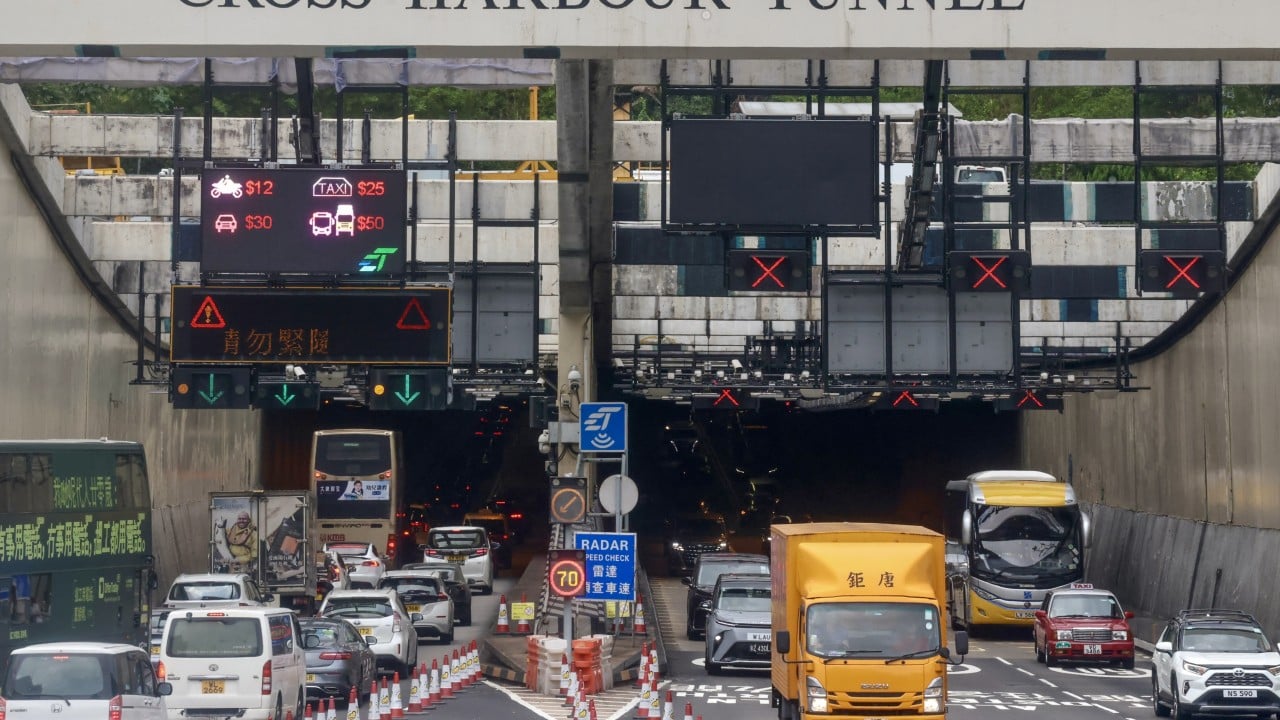
The Hong Kong government’s decision to reduce Cross-Harbour Tunnel (CHT) tolls for taxis by 50%—lowering the fee from HK$10 to HK$5—functions as a psychological victory for drivers rather than a structural economic benefit for passengers. While the policy aims to alleviate traffic congestion via the "Time-to-Time" charging model, the fundamental cost structure of a taxi journey remains insulated from these marginal toll adjustments. For the passenger, the financial friction of crossing the harbor is not dictated by the toll itself, but by the Return Toll Surcharge and the Supply-Demand Imbalance inherent in point-to-point transit.
The Architecture of Passenger Cost
To understand why a 50% toll reduction fails to move the needle for the consumer, one must deconstruct the total cost function of a cross-harbor trip. The passenger’s expense is defined by the following variables:
- Flag-fall and Distance Tariff: The base cost of the vehicle’s operation.
- The Outbound Toll: The actual fee charged by the tunnel operator.
- The Return Toll Surcharge: A regulatory mechanism allowing drivers to charge passengers for the anticipated cost of returning to their original territory (Hong Kong Island or Kowloon).
The second and third variables are where the policy loses its impact. Under the previous regime, a passenger using the CHT paid the HK$10 toll plus a HK$10 return surcharge, totaling HK$20 in "tunnel fees." Under the new 50% reduction, the passenger pays HK$5 plus a HK$5 return surcharge, totaling HK$10. On a HK$150 trip, this represents a nominal saving of 6.6%. This marginal gain is frequently negated by the Opportunity Cost of Congestion. If the toll reduction incentivizes more vehicles to use the CHT, the resulting increase in "idling time" charges (waiting time) quickly exceeds the HK$10 saved on the toll.
The Return Toll Fallacy and Driver Incentive Alignment
The HK$5 return surcharge remains the primary friction point. From a driver’s perspective, the reduction in tolls does not change the "Deadhead" risk—the probability of returning across the harbor without a fare. Because Hong Kong taxi licenses and operations are largely regionalized by driver preference and shift-change locations, a driver based in Kowloon who drops a passenger in Central still faces a high probability of an empty return trip.
This creates a Negative Incentive Loop:
- The lower toll makes the CHT more attractive to private cars, increasing congestion.
- Increased congestion reduces the "Trips Per Hour" (TPH) metric for taxi drivers.
- Drivers, seeking to maximize TPH, avoid the CHT despite the lower toll, favoring the Western Harbour Crossing (WHC) for speed or refusing cross-harbor fares entirely during peak hours.
The government's logic assumes that price elasticity for tunnel usage is high among taxi passengers. In reality, the cross-harbor taxi market is driven by Utility and Time Sensitivity. A passenger choosing a taxi over the MTR (Mass Transit Railway) has already demonstrated a willingness to pay a premium for time. Therefore, a HK$10 price swing is statistically insignificant compared to the value of the time lost in CHT traffic.
The Time-to-Time Charging Bottleneck
The implementation of "Time-to-Time" charging—varying tolls based on peak, transitional, and off-peak hours—introduces a layer of complexity that the current taxi meter system is ill-equipped to handle. While private cars face dynamic pricing, the standardized taxi toll for all three tunnels (CHT, Eastern Harbour Crossing, and WHC) was intended to simplify the fare structure.
However, the standardization at HK$25 for taxis across all tunnels (while the CHT remains cheaper for other vehicles in certain brackets) creates a Relative Price Distortion.
The Congestion Displacement Effect
When tolls are lowered at the CHT specifically for taxis, it should theoretically divert taxi traffic away from the WHC and EHC. However, the CHT is already operating at 150% of its design capacity during peak hours. By lowering the entry barrier (the toll), the government is subsidizing the use of a failing infrastructure node. This is a classic "Tragedy of the Commons" scenario where the individual driver’s rational choice to use the cheapest tunnel leads to a collective outcome of total gridlock, which ultimately harms the passenger.
The Revenue Neutrality of the Fleet Owner
In the Hong Kong taxi ecosystem, the driver is often a sub-lessee of the vehicle. The reduction in tolls does not result in lower rental costs for the driver, nor does it increase the driver's net take-home pay in a meaningful way if the TPH decreases due to traffic.
If we model the driver’s profit ($P$):
$$P = (F \times n) - (R + G + T)$$
Where:
- $F$ = Average Fare
- $n$ = Number of trips per shift
- $R$ = Shift Rental
- $G$ = Fuel/Gas costs
- $T$ = Total Tolls paid
The government's intervention only affects $T$. However, if $T$ decreases by 50% but $n$ (number of trips) decreases by 10% due to increased CHT congestion, the driver’s total profit $P$ actually shrinks. Because the passenger's demand is tied to $n$ (availability), the passenger sees a decrease in service quality (longer wait times, more "no-go" drivers) that far outweighs the minor reduction in $F$.
Structural Misalignment in Urban Planning
The failure to pass on benefits to passengers stems from treating the taxi toll as an isolated variable rather than a component of the Intermodal Transport Strategy.
The MTR remains the dominant cross-harbor competitor. For a taxi to be competitive, it must offer a "Speed Premium." By narrowing the toll gap between the CHT and the more efficient WHC, the government inadvertently encourages drivers to funnel into the most congested artery in the city. To actually benefit the passenger, the toll policy would need to be inverted:
- Subsidize the WHC usage for taxis during peak hours to maintain the Speed Premium.
- Eliminate the Return Toll Surcharge entirely through a digitized clearinghouse that compensates drivers for return trips via GPS verification.
The current 50% reduction is a blunt instrument. It ignores the Shadow Price of Time—the amount a passenger is willing to pay to avoid one minute of traffic. In Hong Kong, this shadow price is estimated to be significantly higher than the HK$10 saved via the toll reduction.
Operational Strategy for Stakeholders
For corporate fleets and high-frequency commuters, the strategic response to this toll change is not to seek the lower-cost tunnel, but to optimize for Route Fluidity.
The data suggests that the CHT will remain a "Value Trap"—low nominal cost, high hidden cost. Logistics managers and frequent travelers should prioritize the Western Harbour Crossing (WHC) despite its higher relative cost for private vehicles, as the taxi toll standardization at HK$25 across all tunnels effectively removes the price penalty for using the faster route.
The primary move is to ignore the CHT discount. The 50% reduction is a diversion; the real efficiency gain lies in the standardized HK$25 taxi toll at the WHC, which represents a massive reduction from previous rates (upwards of HK$75). Passengers should specifically request the WHC to leverage the new flat-rate taxi toll, effectively purchasing 15-20 minutes of time for a negligible delta in total fare. This is the only way to extract actual value from the government’s tunnel reform.
Drivers who adapt to this by positioning themselves near WHC egress points will see a higher TPH and lower fuel consumption per kilometer, outperforming those who gravitate toward the artificially cheapened CHT. The "win" is not in the $5 saved at the CHT, but in the $50+ of time-value recovered by utilizing the standardized WHC rate.