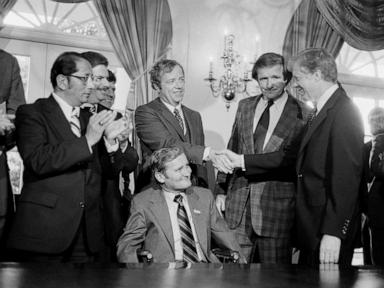
The death of Donald Riegle at 88 marks the closure of a specific era in American legislative history, defined by a 28-year tenure that spanned the transition from the Great Society to the post-Cold War neoliberal consensus. To analyze Riegle’s career is to examine the mechanics of political survival within the Michigan manufacturing corridor and the volatility of federal financial regulation during the late 20th century. His trajectory—from a "Young Turk" Republican in the House to a powerful Democratic Chairman of the Senate Banking Committee—offers a case study in ideological realignment and the systemic risks inherent in the intersection of campaign finance and institutional oversight.
The Structural Evolution of a Five-Decade Political Identity
Riegle’s career was not a linear progression but a calculated adaptation to the shifting tectonic plates of Michigan’s electorate. Elected to the House of Representatives in 1966 as a Republican, he initially represented a brand of moderate-to-liberal Republicanism that has since been functionally extinguished. His 1973 formal switch to the Democratic Party was a recognition of three distinct environmental pressures:
- Executive-Legislative Friction: Riegle’s vocal opposition to the Vietnam War and the Nixon administration’s domestic priorities created an untenable position within the GOP caucus, effectively capping his influence.
- Labor Alignment: Michigan’s political economy was dominated by the United Auto Workers (UAW). For a representative from Flint, the inability to fully integrate into the labor-Democratic alliance represented a strategic ceiling.
- The Post-Watergate Realignment: By switching parties, Riegle positioned himself to ride the massive 1974-1976 Democratic wave, which provided the momentum necessary for his 1976 Senate victory.
This transition solidified his position for nearly two decades, allowing him to navigate the presidencies of Lyndon B. Johnson, Richard Nixon, Gerald Ford, Jimmy Carter, Ronald Reagan, George H.W. Bush, and Bill Clinton. The longevity of this tenure was predicated on his role as a legislative advocate for the automotive industry, ensuring that federal policy—particularly regarding trade and fuel standards—did not disrupt Michigan's primary economic engine.
The Banking Committee and the Cost of Regulatory Capture
The most critical phase of Riegle’s career coincided with his chairmanship of the Senate Banking, Housing, and Urban Affairs Committee (1989–1995). This period was defined by the Savings and Loan (S&L) crisis, a systemic failure of the thrift industry that ultimately cost taxpayers approximately $132 billion.
Riegle’s involvement as one of the "Keating Five" serves as a primary example of how constituent service and campaign finance can compromise the regulatory firewall. The mechanism of the scandal involved five senators who intervened with federal regulators on behalf of Charles Keating, the chairman of Lincoln Savings and Loan. The logical failure in Riegle’s position was the conflation of "constituent advocacy" with "regulatory interference."
The Keating Five Mechanism of Influence
The breakdown of the oversight function during this period can be categorized into three specific failures of governance:
- Proximity Bias: Senators argued they were merely protecting a significant donor from "aggressive" regulation. However, in the context of the S&L industry, aggressive regulation was the only viable tool to prevent insolvency caused by high-risk real estate investments.
- The Regulatory Chill: Legislative pressure on the Federal Home Loan Bank Board (FHLBB) created a delay in the seizure of Lincoln Savings. This delay allowed the institution to continue accruing losses, which were ultimately socialized through the Federal Savings and Loan Insurance Corporation (FSLIC).
- Institutional Reputation Loss: While the Senate Ethics Committee did not find Riegle guilty of illegal acts, it concluded that his "conduct gave the appearance of being improper." This distinction is critical; it highlights a systemic flaw where legal compliance does not equate to functional institutional integrity.
Despite the reputational damage of the Keating Five investigation, Riegle remained a dominant force in shaping the Credit Home Ownership Equity Act (HOEPA) and the Riegle-Neal Interstate Banking and Branching Efficiency Act of 1994. The latter was a transformative piece of legislation that dismantled the barriers to interstate banking, fundamentally altering the American financial landscape by allowing banks to operate across state lines without maintaining separate capital structures for each state.
The Michigan Economic Engine and Trade Protectionism
Riegle’s legislative priorities were tethered to the industrial health of Flint and Detroit. His strategy was built on the principle of defensive trade policy. He was a fierce critic of the North American Free Trade Agreement (NAFTA), arguing that the removal of trade barriers would lead to a structural exodus of manufacturing capital to low-wage jurisdictions.
His opposition was rooted in a specific economic logic: the "hollowing out" of the middle class. Riegle posited that the decoupling of American labor from American consumption would lead to a long-term decline in the tax base of Midwestern municipalities. This foresight proved accurate in the context of Flint, which suffered a catastrophic economic and demographic contraction in the decades following NAFTA’s implementation.
He leveraged his position to secure federal investment in urban renewal and healthcare, recognizing that as private sector industrial support waned, the reliance on federal backstops would increase. His work on the Affordable Health Care for the 21st Century Act (a precursor to later reform efforts) attempted to address the rising cost of employer-provided insurance, which was becoming a significant competitive disadvantage for the "Big Three" automakers.
The Logic of Professional Transition
Riegle’s decision not to seek re-election in 1994 was a response to a shifting political climate where the Keating Five legacy and the rise of Newt Gingrich’s "Contract with America" threatened his incumbency. His post-Senate career at Shandwick Public Affairs and as a professor at Michigan State University represented a pivot from policy creation to strategic advisory and institutional memory.
His career demonstrates the "incumbency paradox": the longer a legislator serves, the more they accumulate the power necessary to protect their district, but the more they become entangled in the institutional compromises required to maintain that power. Riegle’s ability to survive seven presidencies was a result of his mastery of this paradox, right up until the point where the national narrative on corruption overrode his local utility.
Strategic Assessment of the Riegle Model
For modern policymakers and analysts, the Riegle era provides three definitive lessons in institutional management:
- The Fragility of Bipartisanship: Riegle’s switch from Republican to Democrat signaled the beginning of the era of ideological sorting. Today, the "moderate" space he once occupied has been replaced by rigid partisanship, making his type of long-term survival through party-switching nearly impossible in a hyper-polarized environment.
- The Regulatory Capture Trap: The Keating Five incident remains the definitive warning against the integration of legislative oversight and campaign fundraising. Effective oversight requires a clinical detachment that is frequently at odds with the financial requirements of modern campaigning.
- Industrial Policy as Social Policy: Riegle understood that in a state like Michigan, economic policy is the foundation of social stability. His failure to stop NAFTA marked the end of the era where a single senator could protect a regional industrial base against the forces of global capital integration.
The final assessment of Donald Riegle must account for the dual nature of his legacy: a tireless advocate for the Michigan worker who simultaneously participated in the systemic lapses that led to one of the greatest financial collapses of the 20th century. His life illustrates the friction between the ideal of the "citizen legislator" and the reality of the "power broker" in an increasingly complex federal bureaucracy.
To understand the current state of American industrial decay or the consolidated power of the banking sector, one must look directly at the legislative foundations laid, and the regulatory opportunities missed, during the Riegle years. The strategic play for current leaders is to decouple regional advocacy from regulatory leniency—a balance Riegle mastered in his early years but struggled to maintain as the financial stakes of the Senate grew.