Zhang Wei leans against the grill of his heavy-duty hauler, the metal still radiating a dull, pulsating heat that competes with the humid air of a Shaanxi evening. He wipes a streak of black soot from his forehead, but the smudge only migrates. This grit is part of him. For twenty years, Zhang has been a cell in the circulatory system of the global economy, moving coal, steel, and consumer electronics across the vast arteries of China. He is a proud man, but he is tired. He is tired of the roar that vibrates through his bone marrow for twelve hours a day, and he is tired of the bitter tang of diesel that seems to have permanently colonized his sense of taste.
His truck is one of millions. Together, they form a massive, growling beast that keeps the world’s second-largest economy breathing. But that breath comes at a staggering cost. Right now, road transport in China swallows nearly half of the nation's oil. It is a dependency that creates a heavy, grey veil over cities and a persistent ache in the balance sheets of logistics firms.
Change, however, is no longer a distant whisper. It is arriving with the quiet hum of a battery.
The Mathematics of a Heavy Heart
To understand why the shift to electric trucks matters, you have to look at the sheer scale of the appetite we are trying to curb. A single heavy-duty diesel truck can emit as much nitrogen oxide as 150 passenger cars. When you multiply that by the millions of vehicles crisscrossing the provinces, the numbers stop being statistics and start being a physical weight.
Industry analysts recently crunched the data to find a startling possibility: China could transition its entire commercial trucking fleet to 100% electric. If that happens, the impact wouldn't just be felt in the smog-clogged streets of Beijing or Shanghai. It would slash the country’s road transport oil consumption by 50%.
That is not a minor adjustment. That is a structural earthquake.
Consider the "oil drain." China currently imports about 70% of its crude oil. Every time Zhang Wei pulls up to a diesel pump, he is participating in a massive transfer of wealth and a precarious reliance on global supply chains that can snap at the slightest geopolitical tremor. By switching the fuel source from imported liquid to domestically produced electrons—often harvested from the massive wind farms in the Gobi or the solar arrays of Ningxia—the country isn't just cleaning the air. It is reclaiming its energy sovereignty.
The Myth of the Weak Battery
For years, the skepticism was thick. Critics argued that batteries were too heavy, the range was too short, and the charging times were a death sentence for the razor-thin margins of logistics companies. They pictured a truck sitting idle for eight hours while a driver stared at a wall, waiting for a slow drip of power.
But the technology didn't stay still. It evolved with a predatory speed.
The breakthrough isn't just in the chemistry of the cells; it's in the way we think about "refueling." In many Chinese industrial hubs, the "charging" problem has been solved by ignoring the charger entirely. Instead, they use battery swapping.
Imagine Zhang Wei pulling his electric rig into a station that looks like a high-tech car wash. He doesn't get out. A robotic arm reaches down, plucks the five-ton spent battery from behind the cab, and slides in a fresh, fully charged unit. The whole process takes three minutes. It is faster than filling a 500-liter diesel tank.
This shift removes the "range anxiety" that has haunted the industry. It turns the battery from a permanent, degrading part of the vehicle into a modular service. The driver owns the truck; the energy provider owns the battery. This reduces the upfront cost of the vehicle—the primary barrier for independent operators—and puts the burden of infrastructure on the giants who can afford it.
The Invisible Stakes of the Cab
The transition to electric is often framed as a corporate or environmental victory, but for the people behind the wheel, the stakes are deeply personal.
A diesel engine is a violent thing. It operates through controlled explosions. For a driver like Zhang, that means a constant, high-decibel thrum and a vibration that leads to chronic back pain and long-term hearing loss. The cabin of a diesel truck is a workspace defined by stress.
Stepping into a modern electric heavy-hauler is a different experience entirely. It is eerily quiet. The torque is instant, meaning the truck doesn't struggle or groan when pulling a full load up a mountain pass in Sichuan. It glides.
"The first time I drove one," Zhang says, "I thought it was broken. I couldn't hear the power."
But the power was there. Electric motors provide maximum torque at zero RPM. In the world of heavy hauling, torque is king. It’s the difference between a sluggish, dangerous merge into highway traffic and a confident, controlled maneuver.
There is also the matter of the "Health Tax." Drivers spend their lives in the slipstream of other trucks. They inhale the concentrated particulates of the convoy. By removing tailpipe emissions, the industry isn't just saving the planet in an abstract sense; it is literally extending the life expectancy of the men and women who drive these routes. We are talking about fewer cases of asthma, reduced rates of lung cancer, and a dramatic drop in the "black lung" equivalent for the modern age.
The Economic Gravity Well
Why is this happening in China first, and with such intensity? It comes down to economic gravity.
China is the world's largest market for commercial vehicles. Because of this, the manufacturing of electric trucks has reached a "tipping point" of scale. When you build ten thousand units, they are expensive. When you build a million, the cost-per-unit plummets.
The Chinese government has also been aggressive with subsidies and mandates, creating "Green Zones" in major cities where diesel trucks are simply banned. This isn't a suggestion; it’s a requirement for survival. If a logistics company wants to deliver to a warehouse in the heart of Shenzhen, they have to go electric.
This creates a virtuous cycle. As more trucks hit the road, more swapping stations are built. As more stations are built, the trucks become more viable for long-haul routes. The infrastructure is catching up to the ambition.
However, it is not all smooth pavement. The electricity has to come from somewhere. If China replaces diesel trucks with electric ones but keeps its coal-fired power plants running at full tilt, the carbon is simply being moved from the tailpipe to the smokestack.
This is where the broader energy transition intersects with the trucking industry. China is currently installing more renewable energy capacity than the rest of the world combined. The goal is to synchronize the "greening" of the grid with the "greening" of the fleet. A truck powered by a wind turbine in Inner Mongolia is a truly zero-emission vehicle. A truck powered by a coal plant is just a slightly more efficient one.
The Burden of Transition
We must be honest about the friction. For a small fleet owner with three trucks and a mountain of debt, the "future" feels like a threat. The initial purchase price of an electric truck, even with subsidies, remains higher than its diesel counterpart.
There is also the "skill gap." Mechanics who have spent forty years stripping down internal combustion engines are now being asked to work on high-voltage systems and complex software. It is a terrifying shift for a workforce that feels the world moving beneath their feet.
But the cost of doing nothing is higher. The "Oil Half" isn't just a number; it’s a vulnerability. Every dollar spent on foreign oil is a dollar not spent on domestic innovation. Every ton of CO2 and particulate matter released is a future healthcare bill that the society will have to pay.
The Ripple Effect
When China moves, the world's supply chains feel the tremor. If the Chinese trucking industry successfully pivots to 100% electric, it will set the global standard for heavy-duty transport. The components—the motors, the power electronics, the standardized battery packs—will become the global commodity.
Logistics firms in Europe and North America are watching. They see the data. They see that the total cost of ownership (TCO) for an electric truck is beginning to undercut diesel, especially when maintenance is factored in. Electric motors have a handful of moving parts; diesel engines have thousands. There are no oil changes, no fuel injectors to clog, no complex exhaust treatment systems to fail.
The math is becoming undeniable.
The New Morning
Zhang Wei finishes his tea and climbs back into his cab. Tonight, he is still driving his old diesel rig. He can feel the familiar shudder as the engine catches, the cloud of blue-grey smoke briefly obscuring his rearview mirror.
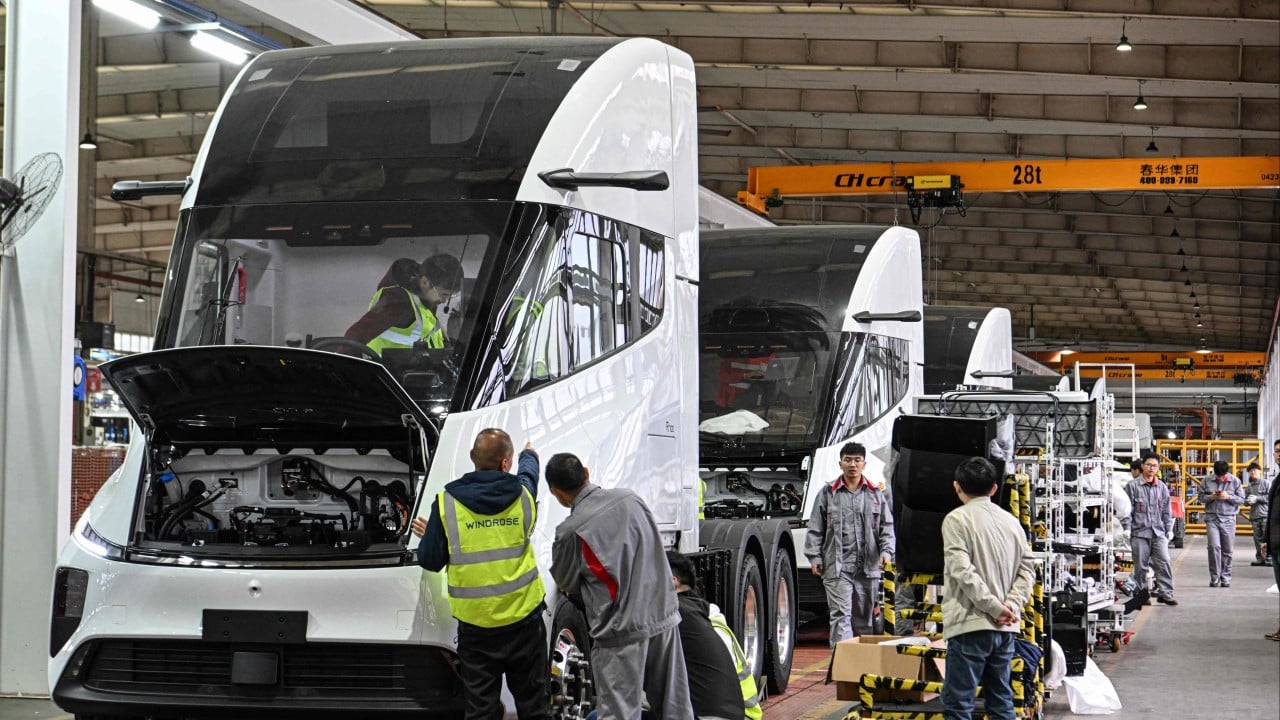
But down the road, at the new logistics terminal, he sees the rows of silent, sleek white trucks plugged into their bays. They look like something out of a dream, or a movie. They don't smell like his youth. They don't roar like his middle age.
He knows that in five years, or perhaps ten, the truck he is driving now will be a relic, a museum piece from an era of noise and soot. The transition isn't just about oil or carbon or 50% reductions. It’s about the fundamental way we move the world.
The change is coming, not with a bang, but with a whisper. It is the sound of a million silent engines, finally allowing the country to catch its breath.
Across the horizon, the first of the electric long-haulers pulls out onto the G30 Expressway. It picks up speed, its tires humming against the asphalt, carrying its load toward the coast. Behind it, the air remains clear. The driver doesn't need to shout to be heard. The silence is the most powerful thing about it.


