The afternoon in Chino Hills, California, carried the kind of suburban stillness that feels permanent. It was a Wednesday, the middle of the work week, where the most pressing concern for most residents was the creeping heat or the evening commute. For one family, the rhythm of a normal life ended with a sound that defied categorization. It wasn't the screech of brakes or the rumble of a distant engine. It was a tectonic crack. A violent intrusion.
Something from the heavens had decided their roof was a landing strip.
The Impossible Projectile
When a fifteen-pound block of ice tears through a residential roof, it doesn't just damage property. It shatters the illusion of the "indoors." We build houses to be our final defense against the elements—the rain, the wind, the biting cold. We don't build them to withstand frozen boulders traveling at terminal velocity from thirty thousand feet in the air.
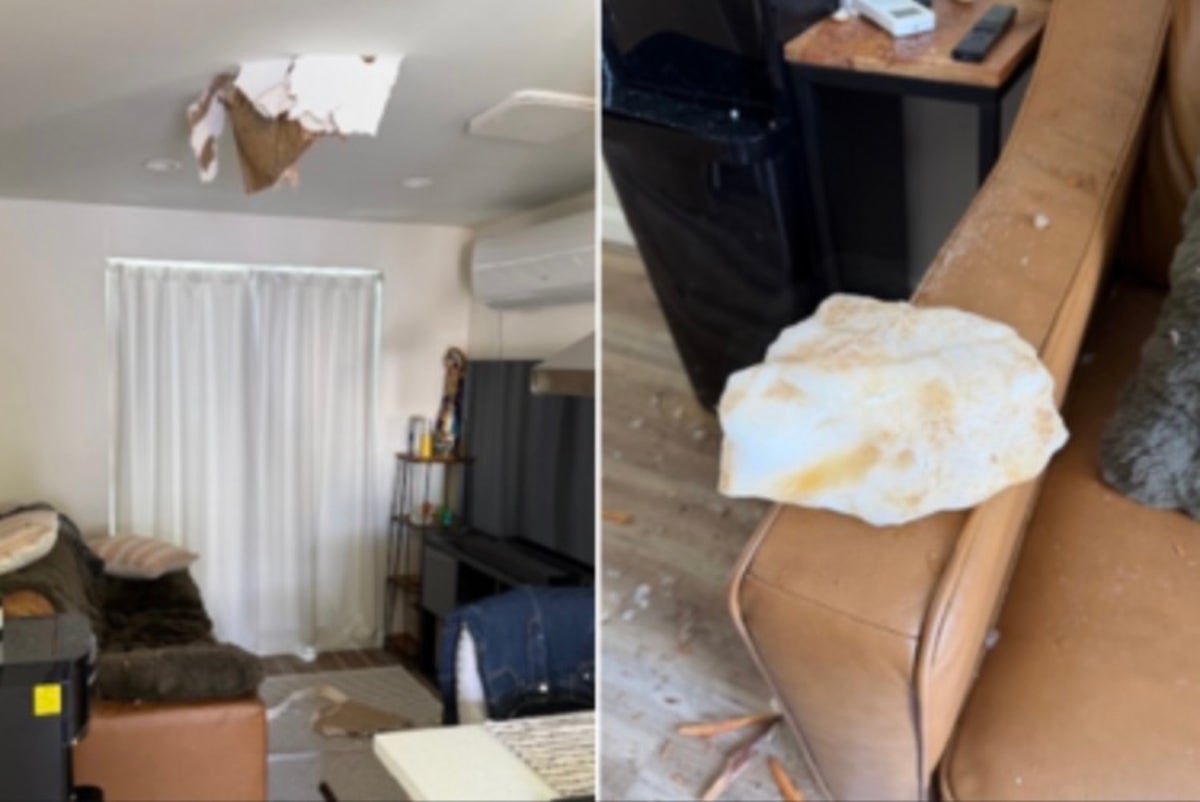
The impact was surgical and devastating. The ice punched through the shingles, the plywood, and the insulation, clearing a path directly into the heart of the home. It didn't stop until it hit the couch. Imagine sitting in your living room, perhaps scrolling through a phone or reaching for a remote, and having the ceiling explode a foot away from your head. This isn't a freak weather event. It’s a physical manifestation of a risk we collectively ignore every time we look up at the white streaks of vapor trails crisscrossing the blue.
The debris left behind wasn't just wood and drywall. It was a jagged, dirty hunk of ice, roughly the size of a bowling ball, sitting mockingly on the upholstery where a human being might have been resting moments prior.
Blue Ice and the Ghost of Logistics
The Federal Aviation Administration (FAA) is currently investigating the incident, a process that involves tracing the flight paths of every commercial and private vessel that passed over that specific coordinate in the minutes leading up to the impact. In the industry, this phenomenon is often whispered about as "blue ice."
Blue ice occurs when a plane’s sewage system develops a leak. The waste liquid, treated with a blue disinfecting chemical, seeps out of a faulty valve. At high altitudes, where the air is a lethal -50°C, that liquid freezes instantly. It clings to the exterior of the fuselage, growing larger and heavier as the flight progresses. It becomes a frozen hitchhiker.
Then, the descent begins.
As the aircraft enters the warmer, denser air of the lower atmosphere, the bond between the ice and the metal weakens. Gravity does the rest. It is a silent, transparent bomb. While modern aviation has made significant strides in sealing these systems, the sheer volume of traffic in southern California's airspace means that even a one-in-a-million failure becomes a statistical certainty for someone on the ground.
The Lottery Nobody Wants to Win
We live in a world governed by "acceptable risk." We accept that driving a car involves a certain percentage of danger. We accept that a storm might knock down a power line. But there is something uniquely haunting about a threat that is entirely invisible and utterly unpredictable. You cannot prepare for a falling block of ice. You cannot buy "Falling Sky Insurance" at a reasonable rate.
Consider the family’s perspective. One moment, you are contemplating what to make for dinner. The next, you are staring at a jagged hole in your ceiling, looking directly at the sky that just tried to kill you. The couch, a symbol of domestic relaxation and safety, is now a crime scene.
The FAA's investigation will likely center on maintenance records. They will look for a specific Boeing or Airbus with a faulty seal, a tiny rubber ring that cost pennies but caused thousands of dollars in damage and nearly cost a life. It is a reminder of how tightly wound our modern world is—how a minor mechanical oversight six miles in the air translates to a shattered living room in a quiet cul-de-sac.
The Weight of the Air
There is a visceral terror in the realization that our ceilings are paper-thin. We spend our lives under a highway of aluminum tubes carrying hundreds of people at hundreds of miles per hour. We hear the hum of the engines and barely look up. It is background noise, the soundtrack of the twenty-first century.
But that noise carries weight.
In Chino Hills, that weight was fifteen pounds of frozen waste and atmospheric condensation. The family escaped physical injury by a matter of feet and seconds. However, the psychological safety of a home is harder to repair than a roof. How do you sleep soundly when you know the sky can reach down and touch you whenever it pleases?
The investigation will eventually close. A tail number will be identified, or perhaps it won't. A check will be written by an insurance company. The hole in the roof will be patched, and the couch will be replaced. But every time a plane rumbles overhead, the residents of that house will likely find themselves glancing upward, waiting for the sky to break again.
We are all living under that same sky. We are all subject to the same physics, the same mechanical failures, and the same terrifyingly random hand of fate. Most days, the air stays where it belongs. But on a random Wednesday in California, the air turned solid, and the world got a little bit smaller, and a lot less certain.
The ice eventually melted into the fabric of the sofa, leaving nothing but a damp stain and a story that sounds like a lie—except for the gaping hole in the ceiling that lets the moonlight in.