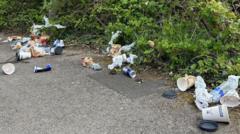
The headlines are predictable. They are lazy. They are wrong.
Every year, a fresh wave of outrage sweeps across the media because 99% of main roads are allegedly covered in litter. The finger-pointing begins immediately. We blame the "clueless driver." We blame the "lazy commuter." We call for higher fines, more cameras, and public shaming campaigns.
It is a comforting narrative. It suggests that the problem is a moral failing of the individual. If we just fixed the "people," the verges would be pristine.
This is a lie.
The filth on our highways is not a symptom of a decaying social fabric. It is a predictable, mathematical outcome of a systemic failure in urban design and logistics. We are treating a structural engineering problem as a behavioral one.
The Myth of the Malicious Tosser
The "lazy consensus" argues that people throw trash out of windows because they don't care.
I’ve spent a decade analyzing logistics and transit flow. Here is the reality: human behavior is remarkably consistent when provided with the right tools. People do not dump trash in their own living rooms. They don't dump trash in a well-maintained airport terminal.
They dump trash on the A1 or the M25 because the "service" of waste management has been entirely removed from the experience of driving.
We have spent forty years optimizing roads for speed and throughput while simultaneously stripping away the "slack" in the system. We removed the bins. We closed the lay-bys. We privatized the service stations until they became high-pressure retail environments where you are expected to buy, eat, and leave within fifteen minutes or face a parking fine.
When you create a high-stress, zero-utility environment, you get friction. Litter is simply the physical manifestation of that friction.
The Bin Paradox
"If we put bins out, people will just fill them up with household waste."
This is the standard line from local councils and national highway agencies. It’s their excuse for removing bins from lay-bys and rest stops. They claim that bins "attract" litter.
Think about that logic. It is equivalent to saying that hospitals attract sick people, so we should close the hospitals to cure disease.
By removing the infrastructure for disposal, you haven't removed the waste. You’ve just shifted the location of the waste from a controlled container to the ecosystem. This is a classic "not in my backyard" (NIMBY) policy implemented at a corporate and governmental level. It’s cheaper for an agency to let trash blow into a ditch—where it becomes an "environmental" issue funded by a different budget—than it is to pay a contractor to empty a bin every Tuesday.
The Packaging Industry’s Free Ride
If we want to find the real culprit, we need to look at the geometry of a McDonald’s bag.
The competitor articles love to show photos of crushed fast-food cups. They use these images to ignite class-based fury against "people who eat junk."
But let’s look at the engineering. Modern drive-thru packaging is designed for one thing: getting the food from the window to the driver’s lap. It is not designed for storage. It is bulky. It is non-collapsible. It is coated in polymers that make it impossible to recycle easily.
We have allowed the food and beverage industry to externalize 100% of their waste management costs onto the public. A "convenience" meal is only convenient because the company doesn't have to deal with the shell of the product once the calories are consumed.
Imagine a scenario where fast-food chains were legally required to provide a waste-return incentive. If every cup had a 50p deposit, you wouldn't see them in the hedges. You’d see people stopping to pick them up.
We don't have a litter problem. We have a "value" problem. We have created a world where the packaging has zero value, and the effort required to dispose of it properly is higher than the perceived social cost of discarding it.
The Aerodynamics of Neglect
Here is a technical truth that most "outraged" journalists miss: a significant percentage of roadside litter doesn't come from car windows.
It comes from the back of poorly secured HGVs (Heavy Goods Vehicles) and skip lorries.
I have watched hours of highway footage. A single skip lorry with a loose net can distribute more debris across a five-mile stretch of motorway than a thousand individual drivers. Wind shear at 60mph turns a loosely packed truck into a confetti machine.
Yet, we rarely see headlines screaming about "Commercial Transport Waste Failures." That doesn't sell papers. It’s much easier to demonize a guy in a Ford Focus.
Why Fines Are a Performance, Not a Solution
The government loves to talk about "tougher fines." It makes them look like they’re doing something while they actually do nothing.
Fines are a regressive tax on the disorganized. They are also nearly impossible to enforce on a moving motorway without an intrusive surveillance state that would cost ten times more than the cleanup itself.
Even if you caught every single person, you wouldn't solve the root cause. You’d just have a lot of angry people and the same amount of plastic in the grass.
The solution isn't "more punishment." The solution is passive engineering.
- Mandatory In-Car Waste Solutions: In the 1970s, every car had an ashtray. We decided smoking was bad, so we took them out. Now, we have a "trash" problem, but we haven't mandated that car manufacturers include integrated, easy-to-empty waste compartments.
- The "Service" in Service Station: We need to stop treating motorways like transit pipes and start treating them like public spaces. This means high-frequency, high-capacity waste disposal points that are accessible without entering a commercial retail trap.
- Producer Responsibility: If your brand is the one most commonly found in a ditch, your corporate tax rate should reflect the cleanup cost. Period.
The Cost of the "Clean" Illusion
There is a downside to my argument. If we actually built the infrastructure—the bins, the collection routes, the industrial waste processing—it would be expensive. It would require a massive shift in how we fund local councils.
But we are already paying the price.
We pay it in microplastics leaching into the soil. We pay it in clogged drainage systems that lead to "unexpected" flash flooding. We pay it in the thousands of man-hours spent by volunteers and underpaid contractors picking up bottles by hand.
The current system is a "disaster by design." It relies on the hope that 70 million people will act against their own immediate convenience in a vacuum of options.
Hope is not a strategy.
Stop Asking "Why Are People So Bad?"
The premise of the question is flawed. People aren't worse than they were thirty years ago. In fact, environmental awareness is at an all-time high.
The problem is that the gap between "intent" and "opportunity" has widened. We have more single-use plastic than ever before, and fewer places to put it than ever before.
If you want clean roads, stop lecturing drivers about their morals. Stop writing "scathing" op-eds about the "state of the country."
Build a bin. Empty the bin. Tax the person who made the bottle.
Everything else is just noise.