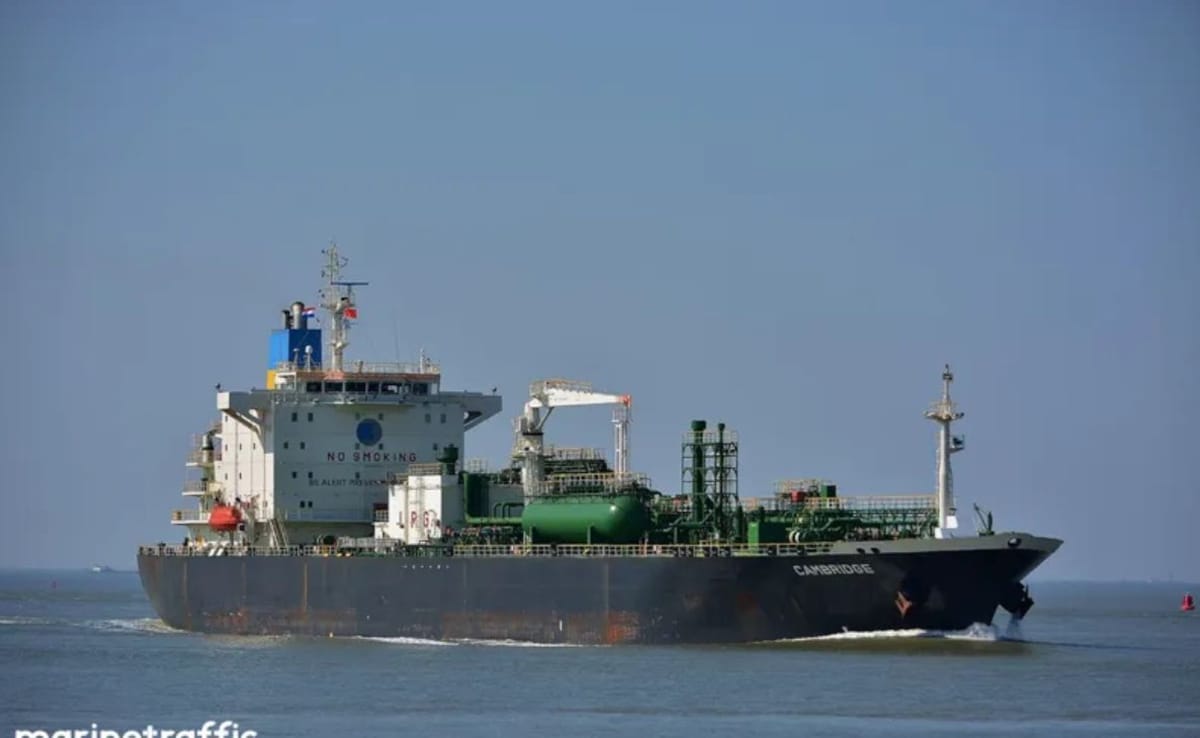
The headlines are screaming victory because a single Indian-flagged vessel finally poked its nose through the Strait of Hormuz. The consensus in Mumbai and Delhi is that the US-Iran ceasefire has cleared the "chokepoint of the world."
They are wrong.
This isn't a return to normalcy. It is a transition into a far more dangerous, high-stakes era of maritime extortion. While mainstream analysts celebrate the "resumption of trade flows," they ignore the reality that the ceasefire has fundamentally rewired the power dynamics of the Persian Gulf. India isn't "securing its energy future"; it is walking into a digital and kinetic cage designed by powers that view merchant sailors as convenient bargaining chips.
The Myth of the Open Sea
The idea that the Strait of Hormuz is now "safe" assumes that safety is a binary state. It isn't. The ceasefire hasn't removed the IRGC (Islamic Revolutionary Guard Corps) fast boats or the US Fifth Fleet's drone swarms. It has simply changed the rules of engagement from "shooting" to "shadowing."
When that first Indian tanker crossed, it didn't do so because the waters were calm. It did so because of a temporary alignment of political desperation. If you are a logistics lead at a major refinery, don't mistake a pause in hostilities for a structural change in risk. The insurance premiums—the "War Risk" surcharges—aren't dropping to pre-crisis levels. Why? Because underwriters know what the pundits don't: a ceasefire is often more volatile than a cold war.
In a state of open conflict, you know who is shooting at you. In a ceasefire, your vessel becomes a tool for "grey zone" signaling. If Tehran wants to squeeze a better deal on frozen assets, or if Washington wants to pressure New Delhi on its Russian oil imports, that Indian vessel in the Strait is the first thing to be "inspected" for a manufactured technical violation.
Why India Is the Biggest Target
The "lazy consensus" says India is the winner here because it sits at the center of the North-South Transport Corridor. That is a dangerous oversimplification. India is actually the most vulnerable player in this new arrangement for three specific reasons:
- Bottom-of-the-Barrel Naval Escorts: While the US and UK have shifted toward high-end autonomous surface vessels for escort duty, the Indian Navy is still relying on traditional destroyer patrols. These are expensive, slow, and easily distracted by asymmetric threats.
- The "Middle Path" Penalty: India tries to play both sides—trading with Iran while maintaining a Strategic Partnership with the US. In a hot war, you pick a side and get protected. In a ceasefire, both sides view you with suspicion. You are the "swing state" of the sea, which means you are the easiest one to bully without starting a global conflagration.
- Refinery Rigidity: Indian refineries are specifically calibrated for Middle Eastern heavy crudes. You can't just flip a switch and process WTI or Brent without massive efficiency losses. This "locked-in" demand means Indian shipping MUST pass through Hormuz. The Iranians know this. The Americans know this. India has zero leverage.
The Electronic Warfare Blindspot
Everyone focuses on the physical ships. Nobody is talking about the signal environment. During the recent tensions, the Strait of Hormuz became a laboratory for GPS spoofing and AIS (Automatic Identification System) manipulation.
Imagine a scenario where an Indian VLCC (Very Large Crude Carrier) believes it is in international waters, but its onboard nav-comms—manipulated by shore-based electronic warfare units—show it drifting into Iranian territorial waters. By the time the captain realizes the discrepancy, the boarding party is already on the deck.
This isn't theory. It’s been happening for years, and the ceasefire does nothing to stop it. In fact, "non-kinetic" interference usually ramps up during a ceasefire because it allows states to project power without technically breaking the peace. India’s merchant fleet is notoriously behind the curve on cyber-resiliency. We are sending analog-minded crews into a digital minefield.
Stop Celebrating the "First Crossing"
Celebrating the first vessel crossing is like celebrating the first person to walk across a frozen lake in late April. It doesn't mean the ice is thick; it means one person got lucky.
The real metric of success isn't "can we get a ship through?" It’s "at what cost?"
If the cost of passage includes:
- Bowing to arbitrary "transit fees" disguised as environmental levies.
- Allowing foreign intelligence services to "verify" cargo manifests.
- Paying triple the standard insurance rate.
...then the Strait isn't open. It’s a toll road owned by a cartel.
The "People Also Ask" Fallacy
People are asking: Is the Strait of Hormuz safe for shipping now?
The honest, brutal answer is: No. It is "permissibly dangerous." The ceasefire is a diplomatic band-aid on a gangrenous limb. If you are a shareholder in a shipping line, you should be demanding to know why the company hasn't diversified its fleet into the Northern Sea Route or invested in more aggressive EW (Electronic Warfare) hardening.
Another common question: Will oil prices drop because of the ceasefire?
Only if you believe in fairy tales. The price of oil in 2026 isn't dictated by physical supply—there’s plenty of that. It’s dictated by the "Geopolitical Risk Premium." As long as the Strait remains a chokehold, that premium stays baked in. The ceasefire just moves the risk from the "Explosion" column to the "Confiscation" column.
The Actionable Pivot
If I were sitting in the C-suite of a major Indian shipping firm, I wouldn't be popping champagne. I would be doing the following:
- Weaponize Your Data: Stop relying on standard GPS. Move to multi-constellation GNSS receivers and invest in inertial navigation systems that don't rely on external signals. If the IRGC tries to spoof your position, you need to know exactly how much they are lying.
- Flag Diversification: The Indian flag is currently a lightning rod. It’s time to look at "flags of convenience" that carry less political baggage in the Gulf, even if it hurts the "Make in India" pride.
- Asymmetric Escorts: Push the government to stop sending billion-dollar destroyers to do the job of a hundred-thousand-dollar drone. We need a "Drone Wall" in the Strait, not a few lonely ships.
The "consensus" wants you to feel comfortable. It wants you to believe the adults are back in the room and the sea lanes are free. But the sea hasn't been free since the first cannon was mounted on a galley.
The Strait of Hormuz is currently a massive game of chicken where the Indian merchant navy is the only player not wearing a helmet. The ceasefire didn't end the crisis; it just turned off the lights so you can't see the blow coming.
Stop looking at the horizon for peace. Start looking at your radar for the next "inspection" team. The crossing wasn't a victory; it was an invitation to be extorted.