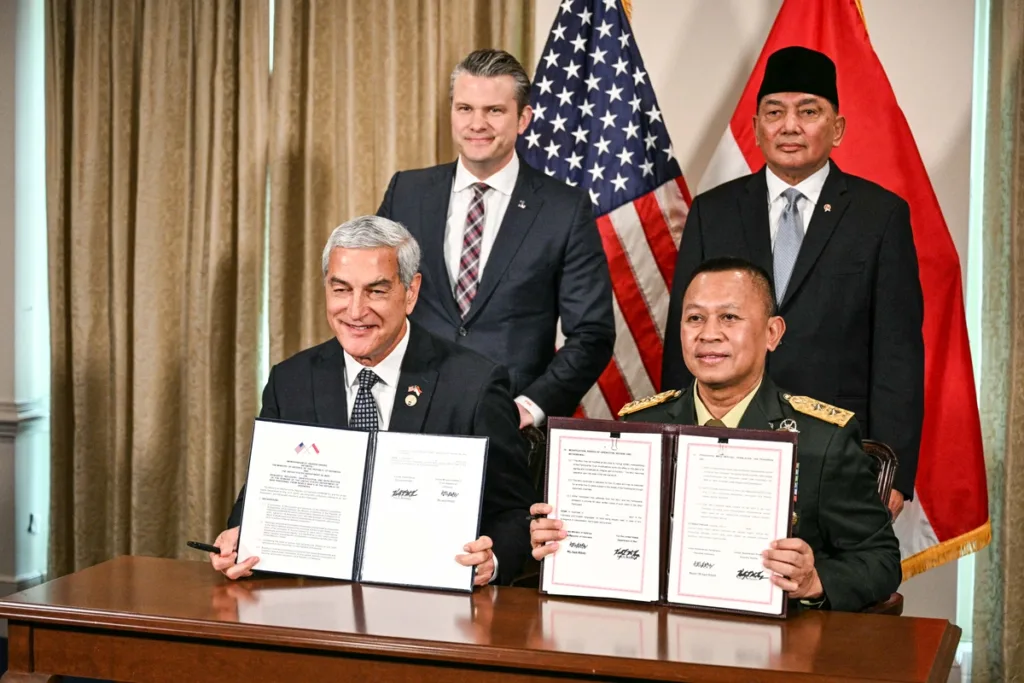
The elevation of US-Indonesia relations to a Comprehensive Strategic Partnership signifies more than a diplomatic upgrade; it represents a fundamental recalibration of the Indo-Pacific security architecture. While public discourse often centers on symbolic cooperation, the functional reality is the creation of a structural bottleneck for Chinese maritime projection. This shift moves Indonesia from a position of "active neutrality" toward a functional integration with the "First Island Chain" defense logic, fundamentally altering the cost-benefit analysis for the People's Liberation Army Navy (PLAN) in the South China Sea.
The Strategic Triad of the Defense Cooperation Agreement
The pact functions through three distinct operational vectors that address specific vulnerabilities in Indonesia’s defense posture while serving US regional objectives. If you found value in this post, you should read: this related article.
1. Domain Awareness and Sensory Integration
The most critical component of the agreement involves the modernization of Indonesia’s Maritime Domain Awareness (MDA). Historically, Indonesia has struggled to monitor its vast archipelagic waters, leaving gaps that Chinese "maritime militia" and survey vessels frequently exploit. The pact facilitates the transfer of advanced radar systems and drone technology, which serves a dual purpose. For Jakarta, it provides the granularity required to enforce sovereignty in the North Natuna Sea. For Washington, it creates a distributed sensor network that feeds into a broader regional common operating picture, effectively shrinking the "blind spots" where Chinese submarines and surface vessels operate undetected.
2. Interoperability and the Logic of Joint Exercises
Large-scale maneuvers like the Super Garuda Shield have evolved from basic infantry drills into complex, multi-domain operations involving paratroopers, amphibious landings, and cyber defense. This creates "procedural muscle memory." In a conflict scenario, the value of this interoperability is found in the reduction of friction. If US and Indonesian forces use synchronized communications protocols and logistics chains, the time required to mount a coordinated response to a maritime incursion drops significantly. This serves as a deterrent by raising the "entry price" for any hostile actor attempting to seize or blockade territory within the Indonesian EEZ. For another angle on this development, refer to the latest update from NBC News.
3. Military-Industrial Decoupling from Non-Western Sources
A subtle but vital pillar of the pact is the transition of Indonesian procurement away from Russian and Chinese hardware. By offering financing for F-15IDN fighter jets and deepening technical cooperation, the US is locking Indonesia into a long-term sustainment cycle with Western technology. Defense platforms dictate decades of dependency for parts, training, and software updates. This architectural lock-in ensures that Indonesia’s high-end military capabilities remain aligned with NATO-standard systems, creating a technical barrier against Chinese integration into Indonesia’s core defense infrastructure.
The Malacca Bottleneck and the Geography of Denial
The geographic reality of Indonesia dictates the strategic value of the pact. Indonesia sits atop the world’s most critical maritime chokepoints: the Malacca, Sunda, and Lombok Straits.
Chinese energy security is tethered to these narrow waterways. The US-Indonesia defense alignment creates a latent threat of "geographical denial." While Indonesia maintains it will not host foreign bases, the pact allows for "rotational access" and "logistics hubs." This distinction is purely semantic in an operational context. If the US can pre-position non-lethal supplies, fuel, and maintenance equipment at Indonesian facilities, it extends the operational reach of the Seventh Fleet without the political baggage of a permanent base.
This creates a strategic dilemma for Beijing. To bypass the Malacca Strait, Chinese shipping must move further south through the Sunda or Lombok Straits—both of which are entirely contained within Indonesian territorial waters. By strengthening Indonesia's ability to police these waters, the US ensures that any Chinese attempt to divert traffic during a crisis would be met by a modernized, US-aligned Indonesian Navy (TNI-AL).
The Economic-Security Paradox
A significant friction point in this partnership is the "Commodity Dependency Loop." China remains Indonesia's largest trading partner and a primary investor in the country’s downstream nickel processing—a sector vital for the global Electric Vehicle (EV) supply chain.
- The Nickel Constraint: Indonesia holds the world’s largest nickel reserves. US attempts to integrate Indonesia into the Inflation Reduction Act (IRA) green energy subsidies are currently hampered by the high level of Chinese ownership in Indonesian smelters.
- The Investment Gap: For the defense pact to remain durable, the US must provide an economic counterweight. If Jakarta perceives that security cooperation brings the risk of Chinese economic retaliation without a commensurate increase in Western investment, the "Active and Independent" foreign policy will swing back toward Beijing.
The pact’s longevity depends on whether the US can decouple Indonesia’s critical minerals sector from Chinese capital, or at least provide a "clean" path for Indonesian exports to enter Western markets.
Risk Variables and Structural Limitations
The partnership is not a formal alliance, and treating it as one is a categorical error. Several constraints limit the depth of this cooperation:
- Constitutional Neutrality: Indonesia’s "Bebas Aktif" (Free and Active) doctrine is not a mere suggestion; it is a foundational political identity. Any perception that Jakarta is becoming a "vessel" for US interests triggers domestic backlash.
- Hardware Heterogeneity: The TNI currently operates a "global patchwork" of equipment, including Russian Su-30s and Chinese missiles. The cost and complexity of transitioning to a purely Western-aligned fleet create a multi-decade transition period fraught with maintenance challenges.
- The South China Sea Calculation: Unlike the Philippines, Indonesia does not view itself as a claimant state in the South China Sea, despite Chinese claims overlapping its EEZ. Jakarta prefers a "law enforcement" approach over a "military" approach to avoid escalating to a state-on-state conflict.
Strategic Forecast and Recommendation
The US-Indonesia Defense Pact will likely result in a "Swiss Cheese" defense layer—not a solid wall, but a series of overlapping capabilities that make Chinese maritime coercion increasingly expensive.
The strategic play for Western planners is to focus on undersea domain awareness. Indonesia’s archipelagic sea lanes are deep and difficult to monitor, making them ideal transit routes for Chinese nuclear-powered ballistic missile submarines (SSBNs) entering the Indian Ocean. By prioritizing the sale of acoustic sensors, maritime patrol aircraft (P-8 Poseidons), and unmanned underwater vehicles (UUVs) to Jakarta, the US can turn the Indonesian archipelago into a transparent environment.
For Indonesia, the objective is to use the pact to achieve "Minimum Essential Force" (MEF) targets that have remained elusive for decades. Jakarta will continue to take US defense tech while simultaneously welcoming Chinese infrastructure investment, playing both sides to maximize its domestic "Golden Indonesia 2045" vision.
The final move in this geopolitical chess match is not the establishment of a US base, but the quiet standardization of Indonesia's military infrastructure. When the runways, fuel ports, and data links in the Natuna Islands are built to US specifications, the physical presence of US troops becomes unnecessary—the capability for rapid deployment is already baked into the geography. This is the definition of modern strategic depth: influence without occupation.


:strip_icc()/pic2513216.jpg)