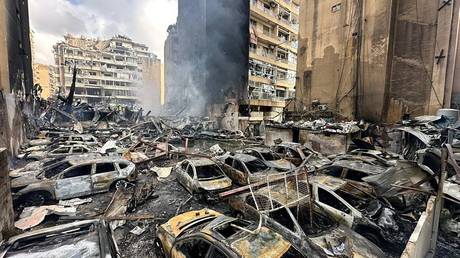
The inclusion of Hezbollah in a formalized ceasefire framework represents a fundamental shift from asymmetric conflict to a structured, diplomatic architecture where non-state actors are granted de facto recognition within international legal instruments. This transition is not a gesture of goodwill but a calculated recalibration of regional leverage, moving from kinetic attrition to a monitored stasis. The recent declarations from the Trump administration signal an intent to codify this shift by moving away from traditional state-to-state diplomacy and toward a "results-oriented" enforcement mechanism that treats Hezbollah as a primary stakeholder in the security calculus, despite its lack of formal state status.
The Tri-Axis Enforcement Model
To understand the mechanics of this ceasefire, one must analyze the three structural pillars that differentiate it from previous failed iterations, such as UN Resolution 1701. The current framework operates on a tri-axis model designed to address the specific vulnerabilities of the Israel-Lebanon border.
- Axis 1: Verification and Immediate Retribution. Unlike previous mandates that relied on passive UN monitoring, this framework introduces a proactive enforcement tier. If a violation is detected via technical surveillance or ground intelligence, the response is not a diplomatic filing but a pre-authorized kinetic counter-measure. This removes the "lag time" of international bureaucracy.
- Axis 2: Economic Linkage. The ceasefire is coupled with Lebanon’s broader economic solvency. By making international financial aid contingent on the stability of the Blue Line, the framework puts domestic pressure on Hezbollah’s political wing. The cost of breaking the ceasefire is no longer just military; it is the total collapse of the Lebanese banking sector.
- Axis 3: Territorial Redirection. The framework necessitates a physical buffer—specifically the withdrawal of heavy weaponry north of the Litani River. The success of this axis depends on the Lebanese Armed Forces (LAF) serving as a buffer, a move that requires significant Western material support to ensure the LAF possesses a qualitative edge over local militias.
The Cost Function of Asymmetric Non-Compliance
For Hezbollah, the decision to enter a ceasefire is governed by a specific cost function. The organization must balance its ideological mandate of "resistance" against the diminishing returns of a war of attrition.
$C(a) = K(t) + E(p) + R(v)$
Where:
- $C(a)$ is the total cost of aggression.
- $K(t)$ represents kinetic attrition—the loss of mid-to-high-level commanders and specialized hardware that cannot be easily replaced due to supply chain disruptions.
- $E(p)$ is the erosion of political capital within Lebanon’s sectarian landscape.
- $R(v)$ is the risk of existential escalation, specifically the possibility of an all-out strike against strategic assets in Beirut.
The current geopolitical climate has increased $K(t)$ and $E(p)$ to the point where the cost of non-compliance exceeds the benefits of continued low-level conflict. By including Hezbollah in the ceasefire language, the U.S. administration recognizes that the group is an "optimizing actor"—they will choose the path of least resistance when their organizational survival is at stake.
The Bottleneck of Sovereign Responsibility
The primary logical flaw in previous peace efforts was the "Sovereignty Gap." International law treats Lebanon as a monolithic state entity, yet the central government in Beirut lacks a monopoly on the use of force. This ceasefire attempts to bypass the bottleneck by creating a direct accountability loop.
When a non-state actor like Hezbollah is "included" in a ceasefire, it creates a paradox of legitimacy. If they adhere to it, they function as a state-like entity; if they break it, they validate the use of overwhelming force against the host nation’s infrastructure. The strategy here is to force the Lebanese state to internalize the externalities of Hezbollah's actions. If a rocket is fired from a specific village, the framework treats that village’s administrative infrastructure as part of the conflict zone, thereby removing the "human shield" or "civilian shield" tactical advantage.
Monitoring Technology as a Force Multiplier
The efficacy of the proposed ceasefire rests on a shift from human-centric observation to automated, multi-spectral surveillance. Human monitors (UNIFIL) have historically been restricted by local interference or political "blind spots." The new enforcement logic utilizes:
- Synthetic Aperture Radar (SAR): Constant monitoring of tunnel entrances and storage facilities that are obscured by cloud cover or darkness.
- Persistent Loitering Munitions: Drones that are not just observing but are linked to a "trigger-ready" command structure, reducing the time between violation and consequence to under 180 seconds.
- Signal Intelligence (SIGINT) Geo-Fencing: Monitoring the electronic signatures of Hezbollah’s communication networks within the exclusion zone. Any activation of tactical frequencies serves as a "tripwire" for an immediate response.
Regional Realignment and the Iranian Factor
Hezbollah does not operate in a vacuum; it is the primary projection of Iranian regional power. The inclusion of the group in a ceasefire negotiated under the shadow of a "Maximum Pressure" 2.0 policy suggests a change in the Iranian strategic calculus. Tehran currently faces a high-stakes choice: allow Hezbollah to be degraded to the point of irrelevance or accept a tactical retreat to preserve the asset for a future date.
The Trump administration's approach leverages this by targeting the financial conduits between the IRGC-QF (Quds Force) and Hezbollah’s executive council. By tightening the "noose" on the illicit oil trade and shadow banking systems, the administration reduces Hezbollah’s ability to pay its rank-and-file and maintain its social service networks (the "State within a State"). Without these funds, the group's "social contract" with its base fractures, making a ceasefire a necessary survival mechanism rather than a diplomatic choice.
The Limitation of Paper Guarantees
A critical risk remains: the "Cheater’s Advantage" in asymmetric warfare. While Israel operates under high visibility and democratic accountability, Hezbollah can utilize clandestine cells to conduct "deniable" attacks. The framework attempts to mitigate this by eliminating the concept of "plausible deniability." Under the new rules of engagement, any kinetic event originating from Lebanese territory is attributed to the Lebanese state and its primary armed militia, regardless of who pulled the trigger.
This creates a high-stakes environment where Hezbollah must now police its own splinter cells or allied factions to prevent a broader escalation that would destroy its remaining infrastructure. It effectively turns the hunter into the gamekeeper.
Strategic recommendation for Regional Stakeholders
The path forward requires a shift from "conflict management" to "structural containment." Investors and regional political entities must look for three specific indicators to gauge the durability of this ceasefire:
- The LAF Deployment Rate: If the Lebanese Armed Forces do not occupy at least 80% of the designated southern buffer zones within the first 60 days, the ceasefire will likely degrade into a low-intensity conflict within six months.
- Sanctions Elasticity: Monitor whether the U.S. Treasury eases or tightens secondary sanctions on Lebanese entities. Easing would suggest a "reward" for compliance; tightening suggests the ceasefire is being used as a tactical pause by the militia.
- The Technical Infrastructure of the Border: The installation of permanent, high-fidelity sensor towers and the removal of "observation tents" are the only physical metrics that matter. Diplomacy on paper is irrelevant without a corresponding change in the topography of the border.
The inclusion of Hezbollah in this ceasefire is not a peace treaty; it is a change in the theater of operations. The conflict has moved from the hills of South Lebanon to the ledger sheets of the Treasury and the tactical screens of automated defense systems. The strategic play is now to maintain the stasis until the non-state actor is either fully integrated into the state or economically starved into obsolescence.