The approval of the Dubai Metro Gold Line represents a shift from organic urban transit expansion to a calculated geopolitical and economic hedge against future population density. At a projected cost of Rs 86,816 crore (approximately $10.4 billion), the 42-kilometer underground network is not merely a transportation project; it is a high-stakes deployment of capital designed to maintain the city's productivity as its demographic profile evolves toward a 5.8 million resident target by 2040. The viability of this project rests on three distinct pillars: subterranean engineering efficiency, the integration of high-density nodes, and the long-term amortization of debt against non-farebox revenue.
The Subterranean Cost Function
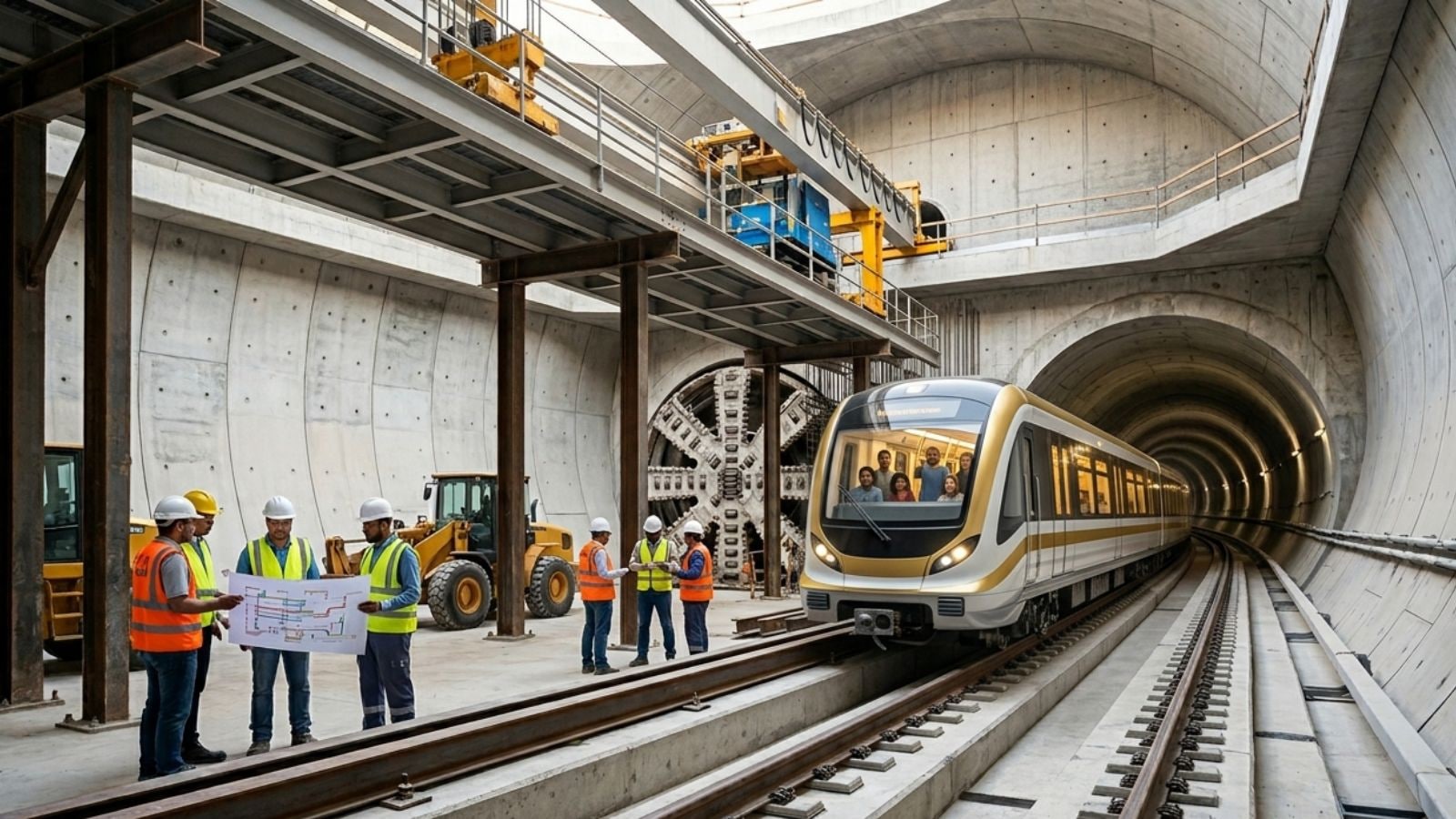
Constructing a 42-kilometer network entirely underground dictates a capital expenditure (CapEx) profile significantly different from the existing Red and Green lines. Underground tunneling in Dubai’s unique geological context—characterized by carbonate-rich sands and high saline groundwater levels—introduces specific engineering risks that scale non-linearly with depth.
The project's cost density, roughly Rs 2,067 crore per kilometer, reflects the necessity for advanced Tunnel Boring Machines (TBMs) capable of maintaining pressure in porous coastal strata. This investment is front-loaded to mitigate the "surface friction" of Dubai’s existing infrastructure. By opting for a 100% underground alignment, the Roads and Transport Authority (RTA) avoids the prohibitive costs of land acquisition and the disruption of critical economic arteries. The logic here is clear: the premium paid for underground construction is an insurance policy against the long-term economic loss that surface-level construction would inflict on the city’s current GDP output.
Network Topology and Throughput Optimization
The Gold Line is strategically positioned to solve the "last mile" deficit of the current radial network. While the Red Line serves as a spine for the city’s North-South axis, the Gold Line acts as a circulatory system for the internal high-density zones.
- Interconnectivity Nodes: The project’s success depends on its ability to interface with the existing 90-kilometer automated network. Efficiency is gained not by the length of the line, but by the reduction in transfer times at major junctions.
- Automated System Resilience: Utilizing Grade of Automation 4 (GoA4)—fully unattended train operation—allows for a higher frequency of service than manual or semi-manual systems. This reduces the headway (the time between trains), effectively increasing the "bandwidth" of the transit corridor without expanding the physical footprint of the stations.
- Urban Densification Logic: The alignment targets areas currently underserved by rapid transit but slated for high-rise commercial and residential development. By providing transit capacity before the peak density is reached, Dubai is practicing "transit-led development," where the infrastructure dictates the shape of the city rather than reacting to existing congestion.
The 2032 Operational Horizon: A Maturity Timeline
A completion date of 2032 places the Gold Line at the center of Dubai’s "Urban Master Plan 2040." This timeline is not arbitrary; it aligns with the anticipated peak of the global shift toward decarbonized urban centers.
The decade-long development phase accounts for the complex lifecycle of subterranean civil engineering:
- Geotechnical Phase (Years 1-2): Identifying seismic risks and soil liquefaction potential.
- Boring and Structural Shell (Years 3-7): The simultaneous deployment of multiple TBMs to ensure linear progress.
- Systems Integration (Years 8-10): Installing signaling, power distribution, and the autonomous control layers.
This timeline also serves as a fiscal buffer. Spreading the Rs 86,816 crore expenditure over ten years allows the RTA to manage cash flow through a combination of government grants, green bonds, and Public-Private Partnerships (PPPs). The 2032 target ensures the system is operational and "burnt-in" before the final 2040 population surge, providing an eight-year window to optimize traffic flows.
Quantifying the Economic Multiplier
The financial justification for the Gold Line extends beyond ticket sales. In modern metro economics, farebox recovery ratios (the percentage of operating costs covered by passenger fares) rarely justify the initial CapEx. Instead, the RTA is banking on secondary economic drivers.
The "Transit-Induced Value Capture" model suggests that property values within a 500-meter radius of new metro stations typically see a 15% to 25% appreciation compared to the market average. By controlling the development rights around the Gold Line’s stations, the government can recapture the capital investment through land auctions and increased property tax yields. Furthermore, the reduction in traffic congestion translates directly into saved man-hours. If the Gold Line reduces average commute times by 15 minutes for 500,000 daily passengers, the aggregate productivity gain to the Dubai economy is millions of hours annually.
Technical Constraints and Potential Bottlenecks
Despite the rigorous planning, several variables could disrupt the Gold Line’s trajectory. The most significant is the "Technical Debt" of integrating new software architectures with the legacy systems of the Red and Green lines.
- Interoperability: If the Gold Line uses a different signaling standard (such as a more advanced version of Communications-Based Train Control), the software handshake between the new and old lines becomes a point of failure.
- Climate Resilience: As global temperatures rise, the energy load required to cool underground stations and tunnels increases. The Gold Line must integrate massive-scale district cooling plants that are significantly more efficient than those currently in use, or risk an operational expenditure (OpEx) spiral that eats into the maintenance budget.
- Labor and Material Volatility: The fixed budget of Rs 86,816 crore is sensitive to the global price of steel, copper, and specialized labor. Any significant inflationary spike over the next seven years could force either a reduction in scope or a request for additional funding, potentially delaying the 2032 opening.
Strategic Asset Allocation
The Gold Line is a physical manifestation of Dubai’s pivot toward a permanent, high-density residential economy. For stakeholders, the focus should not be on the headline cost but on the execution of the station-area developments. The 42-kilometer network is a skeleton; the commercial muscle must be built around it.
To maximize the return on this Rs 86,816 crore investment, the RTA must prioritize the digital layer of the project as heavily as the physical tunneling. This means implementing predictive maintenance algorithms from day one to extend the lifespan of the rolling stock and using real-time data analytics to adjust train frequencies based on live demand. The move to an entirely underground network is a clear signal: Dubai is no longer expanding outward, but inward and downward, optimizing every square meter of its urban core.
The ultimate metric of success for the Gold Line will not be its 2032 opening, but its ability to maintain a sub-30 minute cross-city transit time as the population scales toward 6 million. Organizations and investors should align their portfolios with the Gold Line’s planned nodes now, as the transition from speculative value to realized infrastructure value begins the moment the first TBM breaks ground.