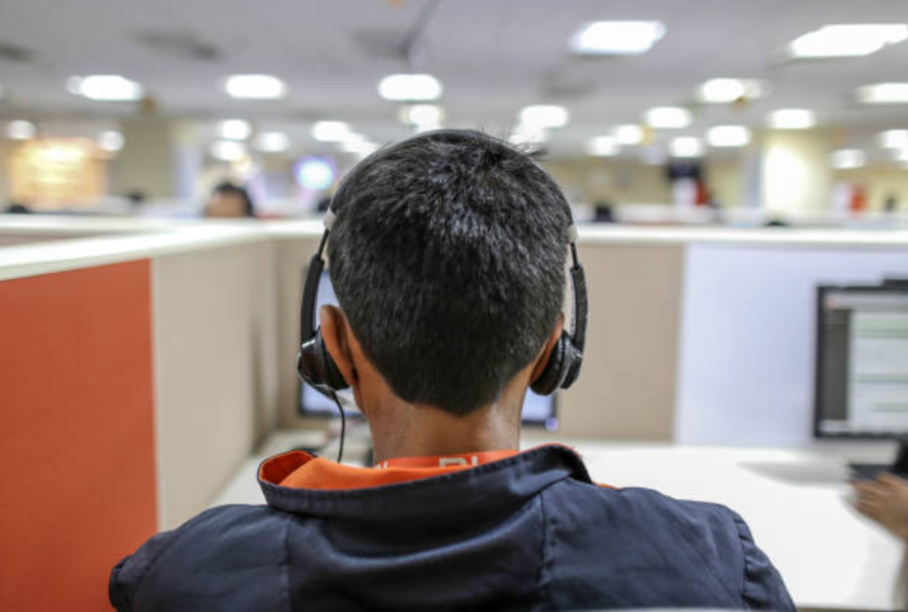
The voice on the other end of the line sounds like it was born in the American Midwest, yet the person speaking is sitting in a darkened office in Manila or Bangalore. This isn't a miracle of linguistics. It is a mathematical overlay. Using real-time generative AI, companies are now scrubbing the native accents of overseas workers and replacing them with "neutral" Western tones. While the tech industry pitches this as a tool for clarity, Canadian unions and labor advocates see it as a digital erasure of identity that threatens the future of domestic employment.
The tension peaked recently when the United Steelworkers, representing thousands of telecommunications staff in Canada, signaled a formal alarm. They argue that "accent masking" isn't just about making a Philippine agent easier to understand. It is a cost-cutting mechanism designed to make offshoring invisible. If a customer cannot tell they are speaking to someone ten thousand miles away, the primary friction of outsourcing vanishes. This removes the last remaining incentive for corporations to keep high-paying service jobs within Canadian borders.
The Mechanics of Digital De-identification
To understand the controversy, you have to look at the signal processing. Traditional noise-canceling software removes hums and background chatter. Accent masking goes deeper. It uses a Low Latency Speech-to-Speech (STS) model. When a worker speaks, the AI analyzes the phonemes and prosody in milliseconds. It then reconstructs that speech using a different vocal profile—typically one modeled on General American English.
The worker still speaks their mind, but the output is filtered. Imagine a hypothetical scenario where an agent in Cebu says "schedule" with a soft 'sh' sound, but the customer in Toronto hears the hard 'sk' common to North America. The software doesn't just change the sound; it adjusts the rhythm and the stress patterns of sentences.
Advocates for the technology, such as San Francisco-based startup Sanas, claim this reduces "bias-driven friction." They argue that customers are often impatient or even abusive when they hear a foreign accent. By masking the accent, they claim to protect the mental health of the worker. Critics, however, find this logic circular. Instead of addressing the xenophobia of the caller, the company forces the worker to wear a digital mask, effectively validating the caller's prejudice.
The Canadian Labour Fortress Under Siege
Canada has long maintained a robust call centre industry, partly because of a cultural emphasis on "neutral" accents and bilingualism. Cities like Moncton, New Brunswick, and Oshawa, Ontario, became hubs for customer service. But as the cost of living in Canada climbs, the wage gap between a Canadian representative and an offshore agent becomes a chasm.
A Canadian worker might earn $22 an hour. An agent in India might earn $4. Historically, the "quality" of the interaction—defined by cultural nuances and ease of communication—justified the higher domestic cost.
AI accent masking breaks that economic equilibrium.
Union leaders point out that if the technology reaches a point of total transparency, the physical location of the worker becomes irrelevant to the consumer experience. This is a nightmare scenario for domestic labor. We are looking at a race to the bottom where the only differentiator is the price of electricity and the lack of local labor laws. The Canadian unions aren't just fighting for the right to hear an accent; they are fighting for the relevance of the Canadian worker in a globalized digital market.
The Psychological Toll of the Filtered Self
There is a human cost to being "re-voiced" every day for eight hours. Psychologists who study workplace identity suggest that speech is intimately tied to one's sense of self. When a corporation tells an employee that their natural voice is a "problem" that needs to be solved by an algorithm, it creates a profound sense of alienation.
Consider the daily routine of an offshore agent. They are already working graveyard shifts to align with North American time zones. Now, they are told their very identity is an obstacle to a "five-star" service rating.
- Inauthentic Interaction: The agent knows the customer is hearing a lie.
- Cognitive Load: Despite the AI doing the heavy lifting, agents often feel pressured to mimic the AI’s output to ensure the software doesn't "glitch" or produce uncanny valley artifacts.
- Cultural Homogenization: The tech assumes there is a "correct" way to speak English, further marginalizing global dialects.
This isn't just about the sound. It is about the power dynamic. The technology is almost exclusively used to make Global South workers sound like Global North residents. You don't see New York executives using AI to sound like they are from Nairobi to "reduce friction" with Kenyan clients. The flow of "improvement" is strictly one-way.
Accountability and the Ghost in the Machine
One of the biggest hurdles for regulators is the lack of transparency. Currently, there is no law in Canada requiring a company to disclose if a voice is being modified by AI. A customer might believe they are talking to a neighbor when they are actually talking to a processed signal.
Transparency matters because it affects how we perceive the economy. If consumers don't know the jobs are gone, they can't vote with their wallets or pressure their representatives. The invisibility of this technology is its greatest asset for the C-suite and its greatest threat to the labor movement.
The United Steelworkers and other organizations are pushing for "Right to Know" legislation. They want companies to admit when they are using AI to modify human speech. They also want protections written into collective bargaining agreements that prevent the replacement of human staff with AI-augmented offshore alternatives. But the law moves slowly, and the software updates every week.
A New Frontier of Corporate Deception
If we allow the masking of accents, where does the simulation end? Companies are already experimenting with "cultural de-masking," where the AI provides the offshore agent with local weather updates, sports scores, and regional slang for the caller’s specific area.
An agent in Delhi could theoretically commiserate about a snowstorm in Montreal that they aren't experiencing, using a voice that sounds like it grew up in Quebec, all while the customer remains blissfully unaware. This is a level of manufactured empathy that borders on fraud.
Businesses argue that this is just another tool, no different from a spellchecker or a professional dress code. But a dress code doesn't alter your vocal cords. A spellchecker doesn't pretend you are someone else. This technology represents a fundamental shift in the "truth" of human communication.
The immediate danger isn't just that the Canadian worker loses their job. It's that the jobs remaining become hollowed out. We are creating a world where the person on the other end of the line is a ghost, stripped of their origin, their culture, and their reality, all to save a few cents on a quarterly earnings report.
The pushback from unions is the first major battle in a much larger war over the "human" element of human resources. If a voice can be synthesized and an identity can be masked, the value of a local workforce drops to zero. The synthetic silence of the call centre isn't just an upgrade. It is a warning.
Stop looking for the AI in the machine and start looking for the AI in the human. When we decide that a person’s natural self is a defect to be patched by software, we have already lost the thread of what it means to conduct business. The solution isn't better filters. It is a return to the reality that a global economy requires us to actually listen to the world, not just a digitized version of ourselves.