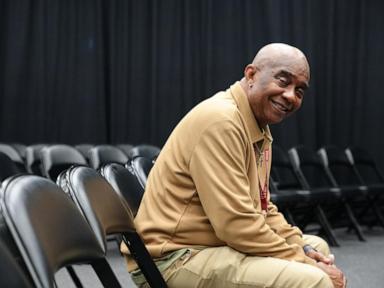
The floorboards of a high school drama room are rarely silent. They groan under the weight of teenage insecurity, the frantic pacing of a lead who can’t find their light, and the rhythmic thud of a chorus line trying to find a collective heartbeat. In most of these rooms, the goal is simple: hit the note, remember the line, don’t trip over the scenery. But in CJ Southerland’s classroom in Georgia, the stage isn't just a place to perform. It is a laboratory for human reclamation.
We often treat the Tony Awards as a glittering fortress for the elite, a night where the gods of the Great White Way descend to hand out gold to their own. Yet, every year, there is a moment where the tuxedoed audience grows quiet for someone they’ve never heard of. This year, the spotlight swerved away from 42nd Street and landed squarely on a teacher who believes that a student’s greatest script isn't written by Sondheim or Miranda, but by the student themselves. Meanwhile, you can read other developments here: Almodóvar and the Price of Resistance in a Bought Industry.
Southerland didn't win the Excellence in Theatre Education Award because his students hit the highest high C. He won because he looked at a generation of kids drowning in digital noise and handed them the one thing they thought they’d lost: their own voice.
The Anatomy of a Silence
Think about a fifteen-year-old walking into a theater department today. They are hyper-perceptive, socially exhausted, and constantly performing for a glass screen in their pocket. For many, theater is just another mask. They want to be told who to be because being themselves feels like a liability. To understand the bigger picture, we recommend the recent article by Entertainment Weekly.
Standard education models suggest we should fill these students with "content." We treat them like empty vessels waiting for the pouring of historical dates or algebraic formulas. In the arts, this often translates to a rigid adherence to the "right" way to act. Speak from the diaphragm. Project. Mimic the masters.
Southerland flipped the script. He realized that before you can teach a child to play a character, you have to help them stop playing the character society forced them to inhabit.
His philosophy is built on the radical idea of self-empowerment. It sounds like a buzzword until you see it in practice. Imagine a student—let’s call him Leo—who has spent three years trying to disappear into the back row of every assembly. Leo is terrified of the spotlight because the spotlight demands a perfection he doesn't think he possesses.
In a Southerland classroom, Leo isn't handed a monologue from Hamlet. He’s asked to tell a story about the last time he felt brave. Or the last time he felt invisible.
Why Storytelling is a Survival Skill
The magic of what happened in Georgia, and what the Tony committee finally recognized, is the shift from performance to narrative. When Southerland emphasizes storytelling, he isn't just talking about plot points. He is talking about the reclamation of agency.
When a teacher asks a student to find the "story" in their own life, they are teaching that student that their life is worth observing. This is the invisible stake of theater education. We aren't just training the next generation of Broadway stars; we are training the next generation of citizens to believe that their perspective has value.
The data bears this out in ways that standard testing fails to capture. Students engaged in this kind of deep, narrative-based arts education show higher levels of empathy and a marked increase in what psychologists call "internal locus of control." They stop believing that life is something that happens to them and start believing they are the ones holding the pen.
But it isn't easy. It’s messy. It involves tears in the rehearsal hall and long conversations about identity that would make a standardized test proctor break out in hives.
The Georgia Method
In the heart of the South, where the pressure to conform can sometimes feel as thick as the humidity, Southerland created a sanctuary. He recognized that the theater is the only place left where we are allowed to be "too much."
Too loud. Too sad. Too hopeful.
He doesn't just teach theater; he teaches the audacity to exist. His students aren't just learning how to block a scene; they are learning how to negotiate space in a world that often wants them to shrink.
Consider the mechanics of a Southerland rehearsal. It’s not a dictatorship. It’s a democracy of the soul. He uses storytelling as a bridge between the abstract art on the page and the concrete reality of a teenager's life. If the play is about grief, he doesn't lecture on the five stages. He asks the room: Where does your hurt live?
By the time the curtain rises, the audience isn't just seeing a play. They are seeing a group of young people who have done the hard work of looking at themselves in the mirror without flinching.
The Tony Award as a Mirror
When the American Theatre Wing announced Southerland as the winner, it wasn't just a win for one man or one school in Georgia. It was a validation of a specific, human-centric way of existing in a classroom.
We live in an era where the arts are often the first thing on the chopping block. They are viewed as a "luxury" or a "distraction" from the "real" work of preparing students for the workforce. The Tony Award for Excellence in Theatre Education argues the opposite. It suggests that there is nothing more practical, more necessary, or more "real" than learning how to tell the truth.
Southerland’s win shines a light on the thousands of teachers who are doing this work in the dark. The ones who stay until 9:00 PM fixing a hem on a costume or listening to a student explain why they can’t go home yet. It acknowledges that the most important work happening in the theater isn't the standing ovation at the end of the night, but the quiet realization a student has in the middle of a Tuesday afternoon: I have something to say.
The Ripple Effect
What happens to a student like Leo after they leave Southerland’s room?
They might never step foot on a professional stage again. They might become nurses, mechanics, lawyers, or parents. But they carry the "Southerland Spark" with them. They know how to listen to someone else’s story because they’ve learned how to value their own. They know how to collaborate, not because they were told to "team build," but because they’ve spent months building a world out of nothing but plywood and passion with thirty other people.
The real "excellence" in theater education isn't found in the trophy cabinet. It’s found in the way these students walk through the world. They walk a little taller. They speak a little clearer. They are harder to silence.
The Ghost in the Wings
There is a haunting beauty in the fact that most of the work Southerland does will never be seen by a Tony judge. It’s in the deleted lines, the failed auditions, and the moments of doubt that happen when the house lights are down.
He didn't win because he produced the most "polished" theater. He won because he understood that the theater is a place where we go to be human together. In a world that feels increasingly fragmented, that is a revolutionary act.
He taught his students that their stories aren't just "Georgia stories" or "teenager stories." They are human stories. And once you realize your story is part of the Great Narrative, you stop being afraid of the dark.
The floorboards in that Georgia classroom are still groaning. They probably always will. But now, they groan under the weight of students who know exactly where they are standing. They aren't just hitting notes anymore. They are claiming their lives.
Somewhere in a small town, a kid is picking up a script for the first time, their hands shaking, their heart hammering against their ribs like a trapped bird. They are terrified that if they speak, the world will laugh. And then, they remember a teacher who told them that their voice is the only thing the world is actually waiting for.
The bird begins to sing.