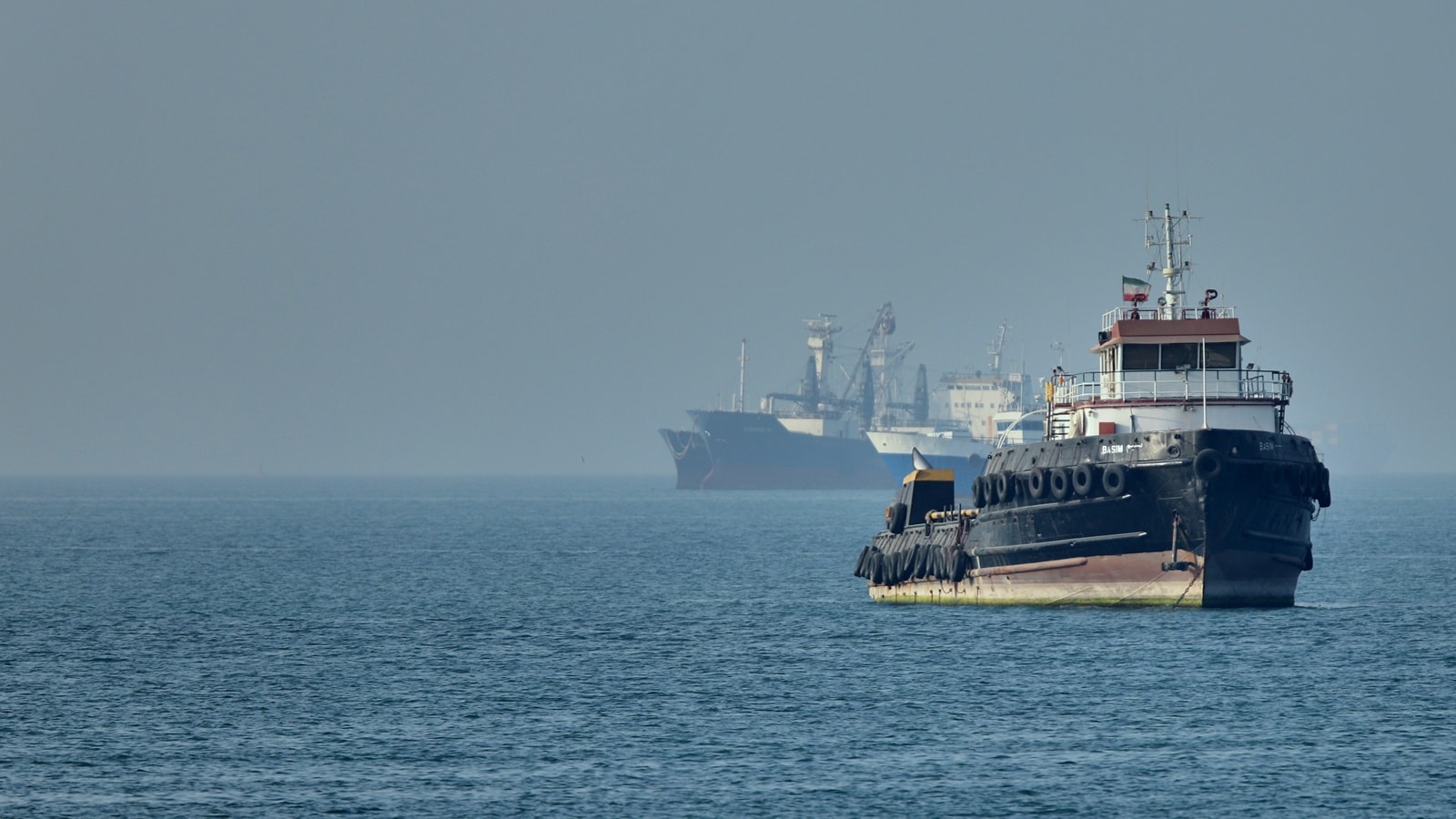
A single spark. That is all it takes to turn the most vital waterway on the planet into a graveyard of steel and a chokehold on modern life.
To understand the Strait of Hormuz, don't look at a map of political borders. Look at the stovetop in a cramped apartment in Seoul. Look at the gas gauge of a delivery truck idling in a London rainstorm. Look at the flickering neon of a Tokyo subway station. These things do not run on money or policy. They run on a steady, rhythmic pulse of crude oil and liquefied natural gas that must pass through a gap in the rocks so narrow that ships can see the shore on both sides.
At its tightest point, the Strait is only twenty-one miles wide. But the actual shipping lanes—the deep-water highways where the massive Very Large Crude Carriers (VLCCs) must travel—are even narrower. Two miles wide for coming in. Two miles wide for going out. Between them lies a two-mile buffer of "don't touch."
If you stand on the deck of a tanker there, the heat is a physical weight. The air tastes of salt and diesel. You are carrying two million barrels of oil. Under your feet is enough energy to power a small country for a day. And you are sailing through a geopolitical trigger wire.
The Ghost in the Machine
Consider a captain named Elias. He is a hypothetical composite of the men who navigate these waters, but his fears are documented in every maritime insurance premium and naval briefing. Elias knows that his ship, a vessel longer than the Eiffel Tower is tall, has the maneuverability of a tectonic plate. If a mine bobbles in the wake, or if a fast-attack craft swerves into his path, there is no "slamming on the brakes."
When tensions between Washington and Tehran escalate, Elias doesn't read the headlines; he feels them. He feels them when the insurance "war risk" premiums for his vessel skyrocket from a few thousand dollars to several hundred thousand for a single trip. He feels them when his crew begins scanning the horizon not for weather, but for the silhouette of a drone or a boarding party.
The world talks about a "blockade" as if it were a neat, military maneuver. It isn't. A blockade in the Strait of Hormuz is a heart attack for the global economy.
One-fifth of the world’s total oil consumption passes through this needle’s eye. That is roughly 20 million barrels every single day. If that flow stops, the impact isn't gradual. It is instant. It is violent.
The Physics of the Panic
The math of a shutdown is brutal. We often assume that if the Strait closes, we just tap into reserves and wait it out. But markets don't wait. Markets are driven by the lizard brain—the part of the human psyche that smells smoke and runs for the exit.
Within hours of a confirmed closure, the price of Brent Crude wouldn't just rise; it would gap up. We are talking about moves of $20, $30, or $50 per barrel in a single trading session. This isn't just a number on a screen.
Every dollar added to a barrel of oil is a tax on every human being who eats food transported by a truck or wears clothes made in a factory. It is a regressive tax that hits the poorest the hardest. When the Strait of Hormuz is threatened, the price of bread in Cairo goes up. The cost of heating a home in Maine becomes a choice between warmth and medicine.
The disruption of 2019 provided a terrifying dress rehearsal. Limpet mines attached to the hulls of tankers. Drones downed. Seizures of vessels like the Stena Impero. During those months, the world held its breath. We saw how easily the "invisible" infrastructure of our lives could be stripped away.
The Myth of Energy Independence
There is a comforting lie often told in the West: that because of domestic fracking and renewable energy, we are no longer tethered to the whims of the Persian Gulf.
It’s a fantasy.
Oil is a global fungible commodity. It doesn't matter if every drop of oil burned in a Texas pickup truck comes from a well in the Permian Basin. If 20% of the world’s supply vanishes from the Strait of Hormuz, the global price resets for everyone. The Texas driller will sell to the highest bidder, which might be a refinery in China or a utility in Italy. The American consumer pays the global rate.
We are all in the same boat. And that boat is currently squeezed into a twenty-one-mile gap between the jagged mountains of Oman and the coast of Iran.
The technical reality of "closing" the Strait is also misunderstood. Iran wouldn't need to sink every ship. They wouldn't even need a full naval blockade. They only need to make the passage "uninsurable."
Lloyd’s of London and other maritime insurers are the silent arbiters of global trade. If they decide the risk of a missile strike or a mine is too high, they withdraw coverage. Without insurance, no commercial tanker moves. The flow stops not because of a physical wall of warships, but because of a legal and financial void.
The Silent Invisible Stakes
Beyond the oil, there is the gas. The Strait is the primary exit point for Qatar’s Liquefied Natural Gas (LNG). In an era where the world is trying to pivot away from coal, LNG is the "bridge fuel." It powers the massive manufacturing hubs of Asia and keeps the lights on in Europe.
If the oil stops, the cars stop. If the gas stops, the factories stop.
Consider the "just-in-time" supply chain. Most modern cities have about three days' worth of food in their local distribution networks. Our world is built on the assumption of a frictionless flow. We have optimized away the buffers. We have sacrificed resilience for efficiency.
The Strait of Hormuz is the place where that efficiency meets the hard reality of human ego and ancient grievances.
The Geometry of Conflict
Why is it so hard to secure?
Because the geography favors the disruptor. The Iranian coastline is a labyrinth of coves, islands, and hidden bases. It is the perfect terrain for "asymmetric" warfare. You don't need a billion-dollar destroyer to stop a tanker. You need a hundred-dollar sea mine. You need a swarm of fast, maneuverable boats equipped with anti-ship missiles.
The U.S. Fifth Fleet, based in Bahrain, exists almost entirely to prevent this scenario. Their job is the ultimate game of chess played in a bathtub. They have to be perfect every single day. The disruptor only has to be lucky once.
When a warship enters the Strait, the crew goes to "General Quarters." The tension is thick enough to cut. They are operating in "littoral" waters—close to shore, where reaction times are measured in seconds. A missile launched from the coast could reach its target before the radar operator has finished identifying the threat.
But the military cost is only the beginning. The environmental cost of a major tanker sinking in those shallow, constrained waters would be an ecological catastrophe that would last decades, poisoning the desalinated water supplies that the Gulf nations rely on for survival. It would be a scorched-earth policy written in black sludge.
The Fragile Thread
We like to think of our civilization as a robust, high-tech marvel. We talk about AI, quantum computing, and Mars colonies. But all of it—every bit of it—rests on a foundation of 19th-century energy moving through 20th-century shipping lanes governed by 18th-century territorial disputes.
We are vulnerable.
It is a vulnerability born of our own hunger. We have built a world that requires 100 million barrels of oil a day to keep the peace. We have funneled that hunger through a geographical fluke.
Next time you flip a light switch, or check the price of a plane ticket, or watch a cargo ship disappear over the horizon, remember Elias. Remember the twenty-one miles. Remember that the distance between "business as usual" and global chaos is the width of a small county, patrolled by nervous men with their fingers on triggers, under a sun that never stops burning.
The Strait isn't just a place on a map. It is the jugular vein of the modern world. And it is currently exposed.