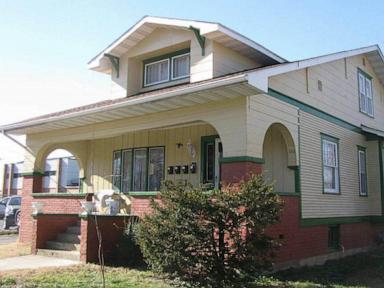
The market value of a residential property traditionally rests on the "Three Pillars of Real Estate": utility, location, and scarcity. However, when an asset like the Benton, Illinois, bungalow where George Harrison stayed in 1963 enters the market, the valuation model shifts from utility-based pricing to associative value extraction. This property represents a unique temporal intersection—the final moment of anonymity for a member of the Beatles before the 1964 arrival at JFK Airport altered the global cultural economy. To understand the true worth of this Illinois home, one must look past the square footage and analyze the mechanics of historical proximity and the scarcity of "Pre-Fame" artifacts.
The Mechanics of Associative Valuation
The "Harrison House" operates as a tangible link to what sociologists call the liminal phase of celebrity. In September 1963, George Harrison visited his sister, Louise Harrison Caldwell, in Benton. At this specific juncture, the Beatles had achieved significant success in the United Kingdom with "She Loves You," but they remained entirely unknown to the American public. This creates a specific Historical Delta: the gap between the subject's internal reality (a rising star) and the external environment (a quiet midwestern mining town).
Property value in this context is driven by three distinct variables:
- Temporal Specificity: The visit lasted roughly two weeks. This narrow window increases the density of the association. Unlike a home where a celebrity lived for decades, which may have undergone numerous renovations, a short-term "touchpoint" property captures a static, unrepeatable moment in time.
- Narrative Provenance: The house serves as the backdrop for specific, documented events—Harrison playing with a local band (The Four Vests) and purchasing a Rickenbacker 425 guitar at a nearby shop. These events convert the physical structure into a narrative anchor.
- Preservation of State: The closer the interior matches the 1963 environment, the higher the psychological "transfer of value" to the buyer. Any modernization of the kitchen or flooring creates a "Value Leak," where the historical connection is diluted by contemporary utility.
The Scarcity of Domestic Beatles Sites
While the UK has a robust infrastructure for Beatles-related tourism—managed largely by the National Trust—the United States possesses very few residential sites with direct, lived-in links to the band members. Most American Beatles "sites" are commercial or performance-based: Shea Stadium (demolished), the Ed Sullivan Theater, or various hotels.
The Benton property occupies a unique niche because it is a Domestic Artifact. In the hierarchy of memorabilia, items that reflect the private, pre-globalization life of a cultural icon command a premium because they are finite. You can print more lithographs; you cannot manufacture more houses where a Beatle slept before the world changed. This scarcity creates a price floor that is detached from the local Benton real estate market. While a standard three-bedroom home in Franklin County might trade at a specific price-per-square-foot, this asset operates in the Global Memorabilia Market, where the competition is collectors and preservationists, not local families.
Structural Challenges in Converting History to Equity
A primary bottleneck in the sale of such a property is the Maintenance-Utility Conflict. The owner faces a binary choice that impacts the exit strategy:
- The Museum Model: Preserving the home as a time capsule. This maximizes historical value but minimizes the property's utility as a residence. It also introduces zoning complexities, as residential neighborhoods are rarely equipped for the traffic generated by "Beatlemania" pilgrims.
- The Hybrid Residence: Living in the home while maintaining the "George Harrison Room." This approach often leads to a degradation of the historical asset over time due to standard wear and tear.
The current market for this Illinois home must also account for the Generational Wealth Shift. The primary demographic for Beatles memorabilia—Baby Boomers—is entering a decumulation phase. The secondary market, composed of Gen X and Millennials, views the Beatles as historical figures rather than contemporary idols. This shift necessitates a change in marketing strategy: the house is no longer just a "fan purchase"; it must be positioned as a Hedge against Inflationary Assets, similar to fine art or rare wine.
The Economic Impact of the "Benton Performance"
The cause-and-effect relationship between Harrison’s visit and the local economy is often understated. By performing at the VFW Hall in Eldorado and visiting local music stores, Harrison inadvertently created a "Geographic Pedigree" for the region. For a prospective buyer, the house is the epicenter of a broader cultural map.
From an investment standpoint, the property’s value is bolstered by the Rickenbacker Correlation. The guitar Harrison bought during this trip is one of the most famous instruments in rock history. The house is the "cradle" of that acquisition. In high-end collecting, an object's value is amplified when it can be linked to other high-value objects. The house isn't just a house; it’s the location where the American Beatles sound began its gestation.
Risk Assessment: The Illiquidity of Niche Real Estate
Prospective investors must recognize the inherent risks of "Celebrity Real Estate." The most significant risk is Asset Illiquidity. Unlike a standard home that can be sold within 30 to 60 days in a healthy market, a historical landmark requires a specific buyer profile:
- A high-net-worth individual with a personal connection to the Beatles' legacy.
- A corporate entity looking for a unique PR asset or "brand home."
- A non-profit or municipal body seeking to drive local tourism.
If none of these buyers are active, the property risks "Stagnation Discounting," where the price must be lowered to meet the local residential market rate, effectively erasing the historical premium. Furthermore, the Distance Factor—Benton is several hours from major hubs like Chicago or St. Louis—limits the property's potential as a high-turnover short-term rental or a frequent-access museum.
Strategic Acquisition Framework
To successfully exit or monetize the Harrison property, the owner must implement a Tiered Monetization Strategy. Relying solely on a "For Sale" sign is insufficient for an asset of this complexity.
First, the provenance must be codified through a "Digital Twin." Every room, fixture, and historical anecdote should be mapped into a high-resolution 3D archive. This preserves the value even if the physical structure undergoes necessary repairs.
Second, the property should be marketed via Auction Houses specializing in Pop Culture, rather than traditional MLS listings. Placing the home alongside rare instruments and original manuscripts targets the "Identity Collector" rather than the "Home Buyer."
Finally, the value proposition must be framed around Cultural Stewardship. The buyer isn't just purchasing a roof and four walls; they are assuming the role of a guardian for a specific millisecond of the 20th century. In a world of digital replication, the "physics of being there" becomes the ultimate luxury. The Benton house is the only place in America where one can stand in the exact space where the 1960s began, months before the rest of the country knew it.
The terminal strategic move for this asset is to decouple it from the local residential market entirely and re-classify it as a Global Heritage Asset. This requires securing local or national historic register status, which provides tax incentives and protects the structure from future development that would cannibalize its historical integrity. By stabilizing the physical asset and aggressively marketing the "Pre-Fame" narrative, the property moves from a stagnant real estate listing to a dynamic investment in the history of global media.