The morning routine is a series of mechanical impulses. You grab the keys from the hook. You juggle a lukewarm coffee and a bag that feels heavier than it did yesterday. The air in Cape Town has a sharp, salty bite to it, the kind that gets under your collar and makes you hunch your shoulders as you walk toward the driveway. You’re thinking about the 9:00 AM meeting, the grocery list, or the strange rattling sound the dishwasher started making last night.
You sit in the driver's seat. You reach for the ignition.
In that split second before the internal combustion engine roars to life, you are the master of a two-ton machine. But beneath you, inches away from the fan belt and the scorching heat of the block, a small, flightless neighbor is looking for nothing more than a bit of warmth.
This isn't a hypothetical scenario designed to tug at your heartstrings. It is the daily reality in Simon’s Town, South Africa, where the African Penguin—a species spiraling toward the brink of extinction—has decided that the suburban underbelly of a Volkswagen is a perfectly reasonable place to take a nap.
The Hidden Neighbor in the Driveway
We often view wildlife through the lens of a documentary. We see them on vast plains or icy shores, framed by the safety of a glass screen. We forget that nature doesn't respect our property lines. In the coastal reaches of the Cape, the boundary between "our world" and "their world" has dissolved.
The African Penguin is a creature of habit and grit. They are "jackass" penguins, named for the braying sound they make, a noise that cuts through the seaside fog like a rusted gate hinge. But they are also desperately vulnerable. Over the last century, their population has plummeted from millions to just a few thousand breeding pairs. Every single bird matters. Every egg is a miracle of survival against the odds.
Imagine the horror of a local resident—let’s call her Sarah—who starts her car on a Tuesday morning, only to hear a sound that haunts her for the rest of the year. It isn't a mechanical failure. It’s the sound of a life being extinguished because of a simple, honest oversight. That trauma ripples. It changes how a person looks at their car, their neighborhood, and their responsibility to the planet.
The Power of a Simple Question
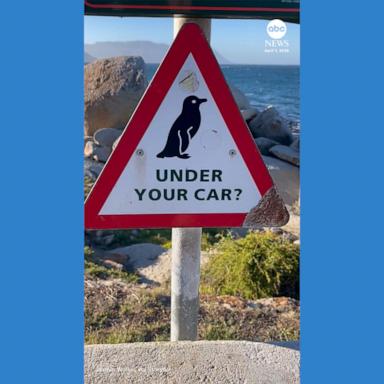
A few years ago, a new fixture began appearing in the driveways and parking lots of Simon’s Town. It wasn't a high-tech sensor or a complex gated system. It was a bright yellow sign. It featured a simple silhouette of a penguin and a question that felt almost whimsical if the stakes weren't so high.
"Penguin under your car?"
This sign didn't demand compliance through threats or fines. It worked because it tapped into a fundamental human trait: the desire to protect. By placing a physical reminder at eye level, the City of Cape Town and local conservationists bridged the gap between mindless routine and conscious action.
The sign forces a pause. It breaks the "autopilot" mode of the morning commute. Suddenly, you aren't just a commuter; you are a guardian. You bend down. You look past the tires. You check the wheel wells.
This small act of mindfulness has proven more effective than any heavy-handed regulation. It turns the residents into active participants in a conservation story. They aren't just living near the penguins; they are living with them.
Why the Engine Bay?
To understand why a penguin would choose a grease-stained chassis over a sandy burrow, you have to look at the world through their eyes. The African sun is relentless. While penguins spend much of their time in the cold Benguela Current, they must come ashore to breed and molt.
A car parked on the street provides two things a penguin craves: shade and a sense of enclosure. To a bird that evolved to nest in guano burrows (which were historically harvested by humans, leaving the birds exposed), the dark, metallic cavern of a car's undercarriage looks like a fortress. It’s a temporary sanctuary from predators like kelp gulls or stray cats.
The engine, still radiating the residual heat from a previous drive, is an added luxury. It’s a deadly irony. The very thing that offers comfort—the warmth of the machine—is the thing that can destroy them the moment the key turns.
The Invisible Toll of the "Standard" Life
We live in a world designed for efficiency. We want our cars to start instantly, our packages to arrive overnight, and our lives to be friction-less. But friction is often where care resides. The "Penguin under your car?" sign introduces a deliberate bit of friction into the day. It asks for thirty seconds of your time in exchange for the life of a bird that has existed for millions of years.
Consider the data. Conservation groups have noted a significant uptick in "rescues" since the signage became a staple of the local landscape. These aren't just statistics; they are individual stories of birds being gently nudged out of wheel wells with a broom or a soft towel, then waddling back toward the ocean, unharmed.
But the success of the sign points to a deeper truth about how we solve modern problems. We are often told that the big issues—climate change, species loss, environmental collapse—require massive, systemic shifts that feel far beyond our individual reach. We feel small. We feel paralyzed.
Then, a yellow sign reminds us that saving a species can be as simple as looking under a bumper.
The Rhythm of Coexistence
There is a specific cadence to life in a place like Simon’s Town. You learn to listen for the braying in the bushes. You learn that the "speed bumps" in the road might actually be a line of birds crossing to reach the water. You learn that your car is not an island; it is a part of an ecosystem.
The success of the sign program has sparked a shift in the local psyche. It’s no longer just about the penguins. It’s about a broader awareness of how our infrastructure intersects with the natural world. If a sign can save a penguin, what can a different kind of lighting do for sea turtles? What can a different kind of fencing do for migrating mammals?
It starts with the question. It starts with the willingness to be interrupted.
The African Penguin doesn't know it’s endangered. It doesn't know that its presence in a driveway is a point of international concern. It only knows the warmth of the pavement and the safety of the shadows. It relies entirely on our ability to see it.
The Long Walk Back to the Water
When you do find one—a stout, feathered hitchhiker tucked behind your front tire—there is a moment of profound connection. You see the salt crystals on its feathers. You see the intense, focused gaze of its eye. In that moment, the abstract concept of "biodiversity" becomes a living, breathing reality that you are holding in your hands (or at least, watching from a respectful distance).
You realize that your morning commute is not the most important journey happening on that street. The penguin’s journey to the water, its hunt for sardines, and its return to a waiting chick in the colony—that is the primary narrative of this place. Your car is just a temporary obstacle in its path.
The signs remain. They fade slightly in the salt air, their yellow paint taking on a weathered patina, but their message never loses its urgency. They stand as silent sentinels, reminding every driver that the world is much more crowded, and much more wonderful, than it appears from behind a windshield.
The next time you reach for your keys, imagine the silence of the driveway. Imagine the small, steady heartbeat just a few inches from your feet. The car is ready to go. The world is waiting. But for just one second, you stop. You look. You make sure the path is clear for a neighbor who cannot ask for the right of way.
The engine stays quiet. The penguin waddles away. The morning begins, and for once, everything is exactly where it belongs.