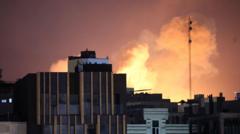
Pakistan has officially crossed the Rubicon. After decades of managing its western border through a complex web of proxies and plausible deniability, Islamabad has declared "open war" on the Taliban government in Afghanistan. This is no longer a series of skirmishes in the high mountain passes of the Hindu Kush. It is a full-scale kinetic confrontation between a nuclear-armed state and a battle-hardened insurgent force that now controls a nation.
The center of this escalation is Bagram Air Base. Once the crown jewel of the American military machine in Central Asia, the sprawling complex north of Kabul has become the target of Pakistani "Operation Ghazab Lil Haq" (Righteous Fury). Local sources and satellite data confirm that on the morning of March 1, 2026, the Pakistan Air Force (PAF) attempted to strike the base, signaling a shift in strategy from targeting border hideouts to decapitating the Taliban’s infrastructure. While Kabul claims its air defenses repelled the jets, the intent is clear: Pakistan is willing to dismantle the very symbols of Afghan sovereignty to stop the Tehrik-i-Taliban Pakistan (TTP).
The Strategic Logic of Striking Bagram
Targeting Bagram is not a random choice. For the Pakistani military, the base represents a dual threat. First, it serves as a central hub for the Taliban’s growing drone capabilities and intelligence operations. Second, it remains a symbol of international interest—specifically American interest—that Islamabad wants to render unusable or irrelevant before foreign powers can re-establish a footprint.
The TTP has spent the last three years using Afghan soil to launch a devastating campaign of suicide bombings and assassinations inside Pakistan. Islamabad’s patience, as Defense Minister Khawaja Asif put it, has "overflowed." By striking Bagram, Pakistan is attempting to force the Taliban’s hand: either hand over the TTP leadership or watch the Afghan state’s limited military assets burn.
The Drone Paradox
The battlefield has changed since the days of the 2001 invasion. The Taliban are no longer just men with AK-47s hiding in caves. They have integrated low-cost, high-impact technology into their defense. In the current conflict, the Taliban have deployed suicide drones against Pakistani military camps with surprising effectiveness. This "democratization of air power" has allowed a cash-strapped government in Kabul to project force across the Durand Line without needing a sophisticated air force.
Pakistan’s response has been to leverage its superior conventional air power. The PAF’s use of precision-guided munitions (PGMs) against 46 locations across Afghanistan, including Kabul and Kandahar, highlights the massive technological gap. However, as the Americans learned over two decades, air superiority does not equal victory in the Afghan terrain.
A Neighborhood in Flames
The timing of this "open war" is a nightmare for regional stability. The escalation coincides with heightened tensions across the Middle East and South Asia.
- China’s Dilemma: Beijing has invested heavily in Pakistan and has been gingerly trying to engage the Taliban for mining and infrastructure projects. A full-scale war between its two neighbors threatens the China-Pakistan Economic Corridor (CPEC) and risks radicalizing the border regions further.
- India’s Shadow: Pakistan has frequently accused the Taliban of being a "proxy for India." While New Delhi has focused on humanitarian aid and diplomatic contact, the Pakistani establishment remains convinced that any Afghan defiance is fueled by Indian intelligence.
- The US Interest: President Donald Trump’s recent suggestions regarding a potential return to Bagram have added a layer of volatility. If the US seeks to reoccupy the base for "over-the-horizon" counter-terrorism, Pakistan’s strikes could be seen as a preemptive move to ensure that any future American presence is on Islamabad’s terms.
The Human and Political Cost
The numbers coming out of the conflict are staggering and, as is typical in war, highly contested. Pakistan claims to have killed over 400 Afghan soldiers and destroyed nearly 200 vehicles. Conversely, the Taliban claim to have killed scores of Pakistani troops and captured border outposts.
Beyond the soldiers, the civilian toll is mounting. Reports from Nangarhar and Paktika provinces describe homes leveled by airstrikes and children among the dead. Every civilian casualty serves as a recruitment tool for the TTP, further complicating the very security crisis Pakistan is trying to solve.
The Taliban's internal cohesion is at stake. If they cave to Pakistan's demands and crack down on the TTP, they risk a rebellion within their own ranks. If they don't, they face a prolonged war against a superior military that can strike their cities at will. For now, Kabul has signaled an openness to talks, but Islamabad has slammed the door shut, demanding action over dialogue.
Pakistan is betting that a short, violent shock will stabilize its border. It is a gamble of historic proportions. If the Taliban refuse to blink, Islamabad may find itself bogged down in a conflict that drains its already fragile economy and fuels an even more potent domestic insurgency. The smoke over Bagram is not just the result of an airstrike; it is the visual evidence of a regional order collapsing into a new, unpredictable era of state-on-state warfare.
Would you like me to analyze the specific satellite imagery changes at Bagram Air Base over the last 48 hours?