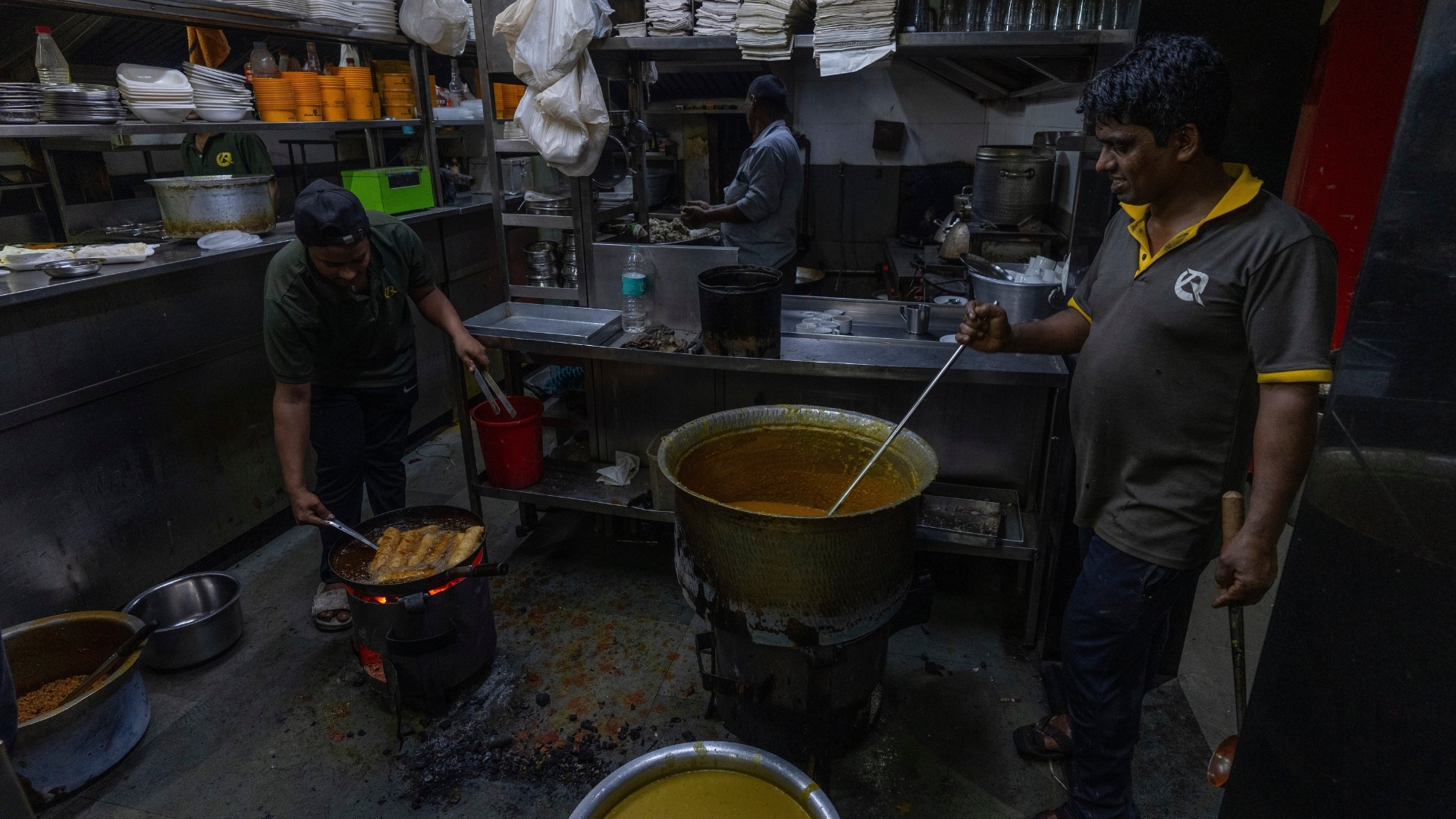
The global energy transition is currently hitting a brick wall in the most basic room of the house. While Western capitals argue over carbon credits and electric vehicle subsidies, nearly 2.3 billion people across Africa and South Asia remain trapped in a primitive energy cycle that turns forests into fuel. The spike in global energy prices has not just made driving more expensive; it has effectively priced the world’s poorest out of modern life. When the cost of liquefied petroleum gas (LPG) or electricity climbs, families do not simply pay more. They revert to charcoal and wood. This shift creates a devastating feedback loop that accelerates deforestation, destroys respiratory health, and anchors regional economies to the ground.
The Broken Ladder of Energy Access
For decades, development economists spoke of the "energy ladder." The theory was simple. As a household's income grows, it moves from "dirty" fuels like dung and wood to "transitional" fuels like charcoal, then to "clean" fuels like LPG, and finally to electricity. It was a linear, optimistic path toward progress.
The reality on the ground in places like Nairobi, Dhaka, or Lagos is far messier. The ladder is missing rungs. When global supply chains tightened and the price of LPG surged by double digits in recent years, the transition did not just stall—it reversed. In many urban centers in sub-Saharan Africa, families who had finally saved enough to buy a gas canister found themselves unable to refill it.
They did not sit in the dark and starve. They went back to the charcoal vendor.
This is not a failure of will or a lack of environmental awareness. It is a survival-based economic calculation. Charcoal is divisible; you can buy a small tin for a few cents when you have a little cash. A tank of gas requires a large upfront payment that many informal workers simply cannot manage when inflation is eating their wages.
The Charcoal Economy and the Forest Floor
The charcoal trade is often treated as a peripheral or informal sector, but in many developing nations, it is a massive, shadow industry that rivals formal energy markets. In sub-Saharan Africa, the charcoal industry is worth billions. It employs millions of people, from the "burners" in rural forests to the transporters and urban retailers.
The environmental cost is staggering. Unlike collecting fallen branches for firewood, charcoal production requires "slow-burn" kilns. This demands the felling of whole trees, often the oldest and hardest woods because they produce the highest-quality charcoal.
As forests near urban centers disappear, the supply chain stretches further into protected areas and across national borders. In the Democratic Republic of Congo and parts of Southeast Asia, this demand fuels illegal logging that is almost impossible to police. The forest is being eaten by the kitchen.
We are seeing a direct correlation between global oil price volatility and the rate of canopy loss in the tropics. When the "clean" alternative becomes a luxury, the "free" alternative—the forest—pays the price.
The Hidden Health Tax
While the ecological damage is visible from satellites, the human damage is visible in the clinics. Indoor air pollution is a silent mass killer. Burning wood, crop waste, or charcoal inside a poorly ventilated home releases a toxic slurry of carbon monoxide and particulate matter.
For a woman cooking over a three-stone fire, the smoke inhalation is often the equivalent of smoking two packs of cigarettes a day. This is not just a health crisis; it is a massive economic drain. Respiratory infections, stunted growth in children, and chronic obstructive pulmonary disease (COPD) in adults remove productive members from the workforce and overwhelm fragile healthcare systems.
Technological "fixes" have often missed the mark. For years, international NGOs flooded these regions with "improved cookstoves." These were supposed to be more efficient, using less wood and venting more smoke. Many ended up used as flowerpots or doorstops. Why? Because they didn't account for cultural realities. A stove that can’t support a heavy pot of maize meal or that requires wood to be chopped into tiny, uniform pieces is useless to a mother of six who is short on both time and tools.
The Subsidy Trap and the Business of Energy
Governments in South Asia and Africa face a brutal dilemma. If they subsidize LPG to keep people from burning wood, they drain their national treasuries and become vulnerable to the whims of the global oil market. If they don't, they lose their forests and their public health.
In India, the Pradhan Mantri Ujjwala Yojana (PMUY) program was hailed as a success for providing millions of poor households with gas connections. But a connection is not the same as sustained use. Data suggests that while many received the initial cylinder, the high cost of refills led to "fuel stacking"—using the gas for a quick cup of tea but reverting to wood for the long-boiling staples like lentils or rice.
The business model for clean cooking is fundamentally flawed because it competes with a "free" resource. You cannot easily sell a commodity to someone who can walk a mile and gather the alternative for the cost of their labor.
Why Solar is Not a Simple Answer
There is a common misconception that we can just "leapfrog" traditional grids with solar power. This works for charging a phone or running a few LED lights. It does not work for cooking.
Cooking is an energy-intensive process. The amount of battery storage and solar panel surface area required to generate enough heat to boil a large pot of water several times a day is still prohibitively expensive for a household earning three dollars a day.
$E = mc\Delta T$
The physics of heating water or grain requires a specific amount of energy ($E$) based on the mass ($m$) and the change in temperature ($\Delta T$). While the cost of photovoltaic cells has plummeted, the cost of the high-discharge batteries needed for thermal loads has not followed the same curve. For the foreseeable future, electric cooking in the world's poorest regions remains a pipedream unless the grid is both reliable and heavily subsidized.
The Conservation Conflict
Conservation efforts often put international organizations at odds with local survival. When a forest is declared a national park to protect biodiversity or sequester carbon, the people living on its fringes lose their primary energy source.
If the "green" transition tells a villager they can no longer cut wood, but offers no affordable alternative, that villager becomes a "poacher" or an "illegal logger" by necessity. True conservation cannot happen in a vacuum of energy poverty. We are currently seeing "carbon credit" schemes where Western companies pay to protect forests, while the people living in those forests are forced to burn them because they cannot afford the gas the West is trying to phase out.
This hypocrisy is not lost on leaders in the Global South. They see a world demanding they protect the "lungs of the planet" while global financial structures make the alternatives to wood-burning increasingly expensive.
A Shift in Strategy
Moving forward requires moving away from the "one-size-fits-all" stove or the "leapfrog" myth. It requires a hard look at the middle of the energy market.
- LPG as a bridge: We must stop treating gas as a "dirty" fuel in the context of the developing world. Compared to wood and charcoal, it is a massive environmental and health win.
- Bio-ethanol and Pellets: Investing in local supply chains for fuels made from agricultural waste can provide a middle ground between the forest and the oil well.
- Micro-grids with thermal capacity: If we want electric cooking, we need grids designed for it, not just for lighting.
The math is simple and cold. If the cost of modern energy remains tied to volatile global markets, the world's remaining forests will continue to be converted into smoke. The energy crisis in the kitchen is not just a local problem; it is the primary obstacle to any global climate goal.
Stop looking at the high-tech solutions in the lab and start looking at the price of a charcoal bag in the market. That is where the battle for the environment is actually being fought.