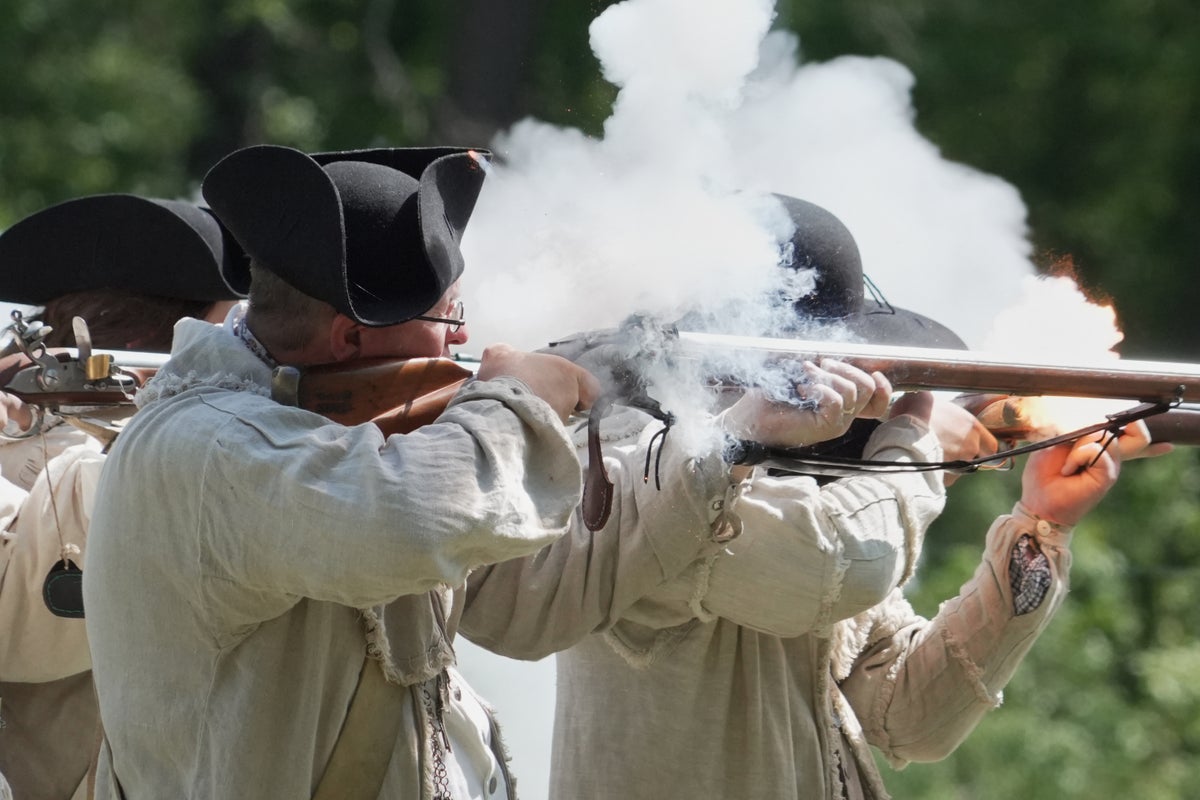
You can walk into a store in most U.S. states, hand over cash, and walk out with a .58 caliber firearm capable of dropping a grizzly bear. No background check. No waiting period. No government paperwork. Federal law doesn't even consider it a "firearm."
While modern semi-automatic rifles dominate every news cycle and political debate, a massive legal loophole exists for black powder weapons. It’s a quirk of the 1968 Gun Control Act that remains largely untouched today. The law defines "firearms" in a way that excludes almost anything made before 1898 or any modern replica of those guns. This isn't just about museum pieces or wall-hangers. It’s about functional, lethal weaponry that stays completely off the grid.
Why the ATF doesn't care about your musket
The Bureau of Alcohol, Tobacco, Firearms and Explosives (ATF) has very specific boundaries. Under the Gun Control Act, an "antique firearm" is any firearm manufactured in or before 1898. It also includes replicas of such firearms as long as they aren't designed to use rimfire or centerfire fixed ammunition. Basically, if it doesn't use a modern cartridge—the kind where the bullet, powder, and primer are all in one neat metal tube—the ATF generally ignores it.
This legal distinction creates a unique reality. Felons, who are strictly prohibited from possessing modern handguns or rifles, often find themselves in a gray area with black powder. In many jurisdictions, a person with a violent criminal record can legally own a muzzleloader. Some states have tightened these rules, but at the federal level, these tools of war from the 1800s are treated more like air rifles or antique furniture than deadly weapons.
It’s a massive gap in the system. We aren't talking about slow, unreliable flintlocks that misfire half the time. We’re talking about modern inline muzzleloaders. These use 209 shotgun primers, synthetic high-performance powders, and aerodynamic saboted bullets. They’re accurate out to 200 yards. They’re devastatingly powerful. Yet, because you load the powder and the lead separately through the front of the barrel, they aren't "guns" in the eyes of the feds.
The lethal reality of black powder ballistics
Don't let the "antique" label fool you. A .50 caliber muzzleloader firing a 300-grain projectile carries a terrifying amount of kinetic energy. For context, a standard 9mm handgun bullet weighs about 115 grains. The musket ball or sabot is nearly three times as heavy. When that much lead hits a target, it doesn't just pass through. It crushes bone and destroys tissue on a scale that modern "assault weapons" often don't.
Historically, the Minié ball—a conical lead bullet used during the Civil War—was responsible for the vast majority of casualties. It moved slow enough to stay inside the body but carried enough mass to shatter every bone it touched. Modern muzzleloaders have only improved on that design. They use scoped optics and rifled barrels. If you're standing in front of one, the fact that the shooter didn't have to pass a NICS background check won't make you any less dead.
The "loophole" isn't just a technicality in a dusty law book. It’s a thriving market. Companies like CVA, Traditions, and Thompson/Center sell thousands of these every year. They're marketed to hunters who want to take advantage of special "primitive weapon" seasons, which often start earlier than general rifle seasons. But the side effect is a secondary market where anyone with a credit card can get a high-powered rifle delivered straight to their front door. No FFL transfer required.
The felon problem and state-level crackdowns
If you’re a "prohibited person" under 18 U.S.C. § 922(g), you can't touch a Glock. But can you touch a Remington Model 700 muzzleloader? At the federal level, the answer is usually yes, because it isn't a firearm. However, this is where things get messy.
Several states have realized this gap and moved to close it.
- In New Jersey, a muzzleloader is legally a firearm. You need a Permit to Purchase.
- Illinois requires a FOID card for black powder weapons.
- California has stricter definitions that trap many of these "antiques" under state-level regulations.
But in "free" states like Texas, Florida, or Pennsylvania, the federal definition usually holds sway. This creates a strange incentive. If you're someone who shouldn't have a gun, a muzzleloader is the ultimate workaround. It’s the "ghost gun" of the 19th century, except it’s perfectly legal and sold at big-box sporting goods stores.
I’ve seen this play out in rural communities. Local police often aren't even sure how to handle it. If they stop a known felon with a percussion cap revolver, is it a crime? If the state law mirrors the federal law, the officer might have to let them go. It’s a frustrating reality for law enforcement and a dangerous one for the public.
Mail order mayhem and the lack of oversight
The most "bizarre" part of this isn't just that you can buy them; it's how you buy them. You can go to a website, put a .44 caliber Pietta 1858 Army black powder revolver in your cart, and pay with a standard Visa. Three days later, the mailman drops it on your porch.
There is no serial number tracking in a central database. There is no record of the sale that the government can easily access. If that weapon is used in a crime, tracing it back to the original owner is nearly impossible unless the bullet itself provides a rare clue. While modern handguns have "ballistic fingerprints" (though that's often an exaggerated concept), a lead ball fired from a smoothbore or even a rifled musket is incredibly difficult to link to a specific barrel after it expands on impact.
We talk about closing the "gun show loophole," but we rarely mention the "1898 loophole." It’s a blind spot in the American consciousness. We've spent decades arguing about magazine capacities and pistol grips while leaving the door wide open for weapons that can literally blow a hole through a brick wall.
The argument for keeping the loophole open
To be fair, there are reasons this law exists. For many, muzzleloading is a hobby, a link to heritage, and a way to participate in challenging hunts. Loading a musket is a slow, methodical process. You have to measure the powder, seat the wad, ram the ball, and place the cap. In a high-stress self-defense situation or a mass shooting scenario, a single-shot musket is objectively less "effective" than a modern firearm. It takes 20 to 30 seconds to reload, even for a practiced hand.
Collectors argue that requiring background checks for 150-year-old antiques would destroy the historical trade. It would turn grandfathers passing down family heirlooms into accidental criminals. They see the muzzleloader as a "primitive" tool that doesn't belong in the same category as an AR-15.
But that argument ignores the "inline" evolution. A modern muzzleloader isn't your great-great-grandfather’s rifle. It’s a high-tech piece of engineering that just happens to use a hole in the front instead of a gate in the back. The intent of the 1968 law was to protect hobbyists and historians, but it didn't anticipate how technology would bridge the gap between "antique" and "lethal precision."
What you need to know if you're buying one
If you're looking into black powder, don't assume the lack of a background check means there are no rules. You still have to deal with the logistics of explosive precursors. Black powder and its substitutes (like Pyrodex) are sensitive. Storage is a legitimate safety concern. You're essentially keeping a small bomb in your garage.
- Know your local laws. Just because the feds say it’s fine doesn't mean your city or state agrees. A "non-firearm" in one zip code is a felony in the next.
- Treat it with the same respect as a modern gun. A .50 caliber hole is a .50 caliber hole. The lack of a serial number doesn't make the weapon any less "real."
- Understand the reloading risk. Overcharging a black powder rifle can turn the barrel into a pipe bomb. It happens more often than people admit.
- Clean it immediately. Black powder is corrosive. If you don't clean that "antique" after one use, it'll be a rusted hunk of junk in a week.
The musket loophole is one of the strangest artifacts of American law. It represents a collision between 18th-century tech and 21st-century regulations. Whether you see it as a vital protection of heritage or a dangerous gap in public safety, it’s a reality that isn't changing anytime soon. The next time you see someone at the range with a smoke-belching rifle, remember that they might be the only person there who didn't have to ask the government for permission to be there.
If you're serious about exploring this, start by checking your specific state's definition of a "prohibited person" regarding black powder. Don't take a "non-firearm" designation for granted. Many people have ended up in legal hot water assuming federal law protected them when state law was much more restrictive. Get a copy of your state’s penal code and look for the specific definition of "firearm." If it mentions "any weapon which will or is designed to or may readily be converted to expel a projectile by the action of an explosive," your musket is a gun in the eyes of the state, regardless of what the ATF says.