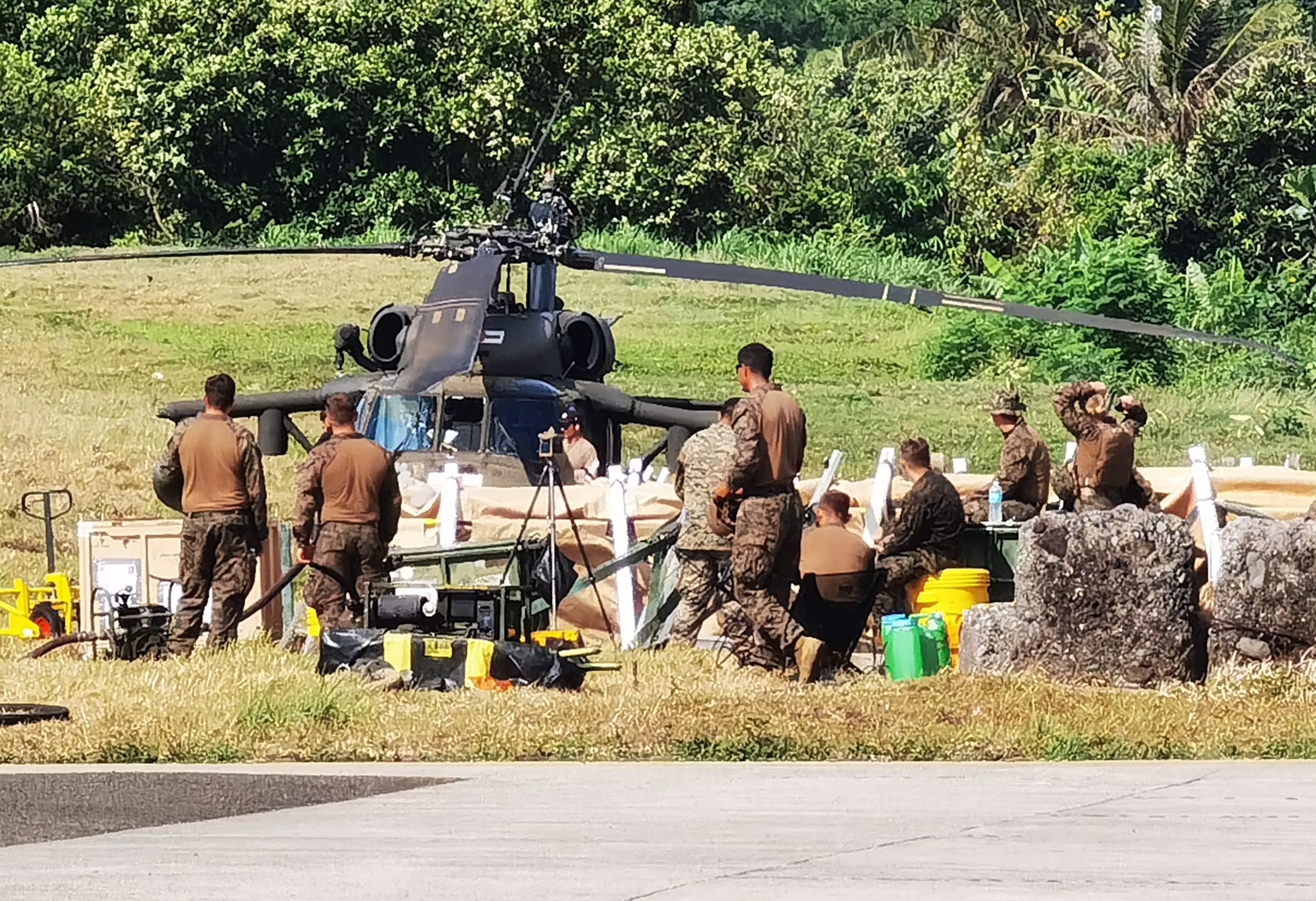
The deployment of over 16,000 personnel across the Philippine archipelago for the Balikatan exercises represents more than a symbolic show of force; it is a live-fire stress test of the Integrated Deterrence framework. By shifting from internal security to external defense, the Philippines and the United States are transitioning from a legacy "tripwire" strategy to a "denial-based" posture. This transition relies on three specific operational variables: territorial decentralization, maritime domain awareness (MDA) integration, and the hardening of the First Island Chain’s kill web.
The Triad of Modern Insular Defense
To understand the scale of these maneuvers, one must categorize the activity into three distinct functional pillars. These pillars move beyond the "readiness" rhetoric and into the cold math of regional attrition.
1. Decentralized Command and Control (C2)
In a high-intensity conflict, centralized hubs are the first casualties. Balikatan 2026 focuses on Distributed Maritime Operations (DMO). This involves spreading assets—missile batteries, logistics nodes, and sensor arrays—across small, austere islands rather than concentrating them at large airbases like Basa or Clark.
The logistical cost function here is high. Operating out of northern Luzon or the Palawan coastline requires a "pulsing" supply chain rather than a steady stream. By practicing "littoral maneuvers," the joint forces are mapping the friction points of moving heavy equipment across non-permissive, underdeveloped terrain.
2. Multi-Domain Sensing and Targeting
The introduction of the Mid-Range Capability (MRC) Typhon missile system during recent cycles changed the tactical calculus. The goal is no longer just "patrolling" but "targeting." The exercise tests the latency between a Philippine Navy sensor detecting a vessel and a U.S. Army firing unit receiving that telemetry.
Effective deterrence is a product of Capability × Will × Communication. If the communication of targeting data (the "Kill Web") is fractured by electronic warfare, the capability is nullified. Balikatan serves as a laboratory for testing frequency-hopping and satellite-independent data links in the South China Sea’s specific atmospheric conditions.
3. Rapid Response and Reinforcement (R3)
The exercises quantify the time-distance problem. The "First Island Chain" is a geographic constraint that favors the regional actor. For the U.S. and its allies (including Australia and France), the objective is to prove that reinforcement can occur faster than an adversary can achieve a fait accompli. This involves:
- Pre-positioning equipment (SORTS).
- Validating runway lengths for C-17 and C-130 operations in remote provinces.
- Testing the "surge" capacity of local civilian infrastructure to support military logistics.
The Mathematics of Interoperability
Interoperability is often treated as a buzzword, but in a consulting sense, it is a technical standard of API-level military integration. The challenge lies in the disparity of hardware. The Philippine Armed Forces (AFP) operate on different maintenance cycles and budget constraints compared to the U.S. Indo-Pacific Command (INDOPACOM).
The logic applied during these exercises follows a Force Multiplication Model:
$$Effectiveness = \sqrt{Asset_{A} \times Asset_{B}} \times Integration_{Factor}$$
When $Integration_{Factor}$ approaches zero (due to poor communication or incompatible doctrine), even massive troop numbers result in negligible strategic impact. Balikatan 2026 seeks to raise this factor by embedding U.S. advisors directly into Philippine tactical operations centers, moving beyond "observer" status into co-managed fire direction.
Strategic Bottlenecks and Geographic Friction
The Luzon Strait and the Palawan corridor are the two most critical geographic "choke points" under scrutiny. The exercises are not conducted in these areas by accident. They are meant to demonstrate the ability to deny access to the "Second Island Chain" and the broader Pacific.
The Palawan Pivot
Palawan serves as the front line for the Kalayaan Island Group. The difficulty here is the lack of deep-water ports and hardened hangars. The current strategy involves Expeditionary Advanced Base Operations (EABO). This doctrine assumes that permanent bases will be targeted and destroyed within the first 48 hours of a conflict. Therefore, the "readiness" being tested is the ability to land, fire a salvo, and relocate before an enemy can cycle their OODA loop (Observe, Orient, Decide, Act).
The Northern Luzon Buffer
Northern Luzon provides the "high ground" overlooking the Bashi Channel. By placing long-range precision fires (LRPF) here, the alliance creates a "no-go" zone for hostile surface vessels. The bottleneck is not the missiles themselves, but the sustainment. A single Patriot or Typhon battery requires a massive footprint of fuel, security, and maintenance. The exercises reveal whether the Philippine road network can actually sustain these "high-footprint" systems during a simulated blockade.
The Role of Non-Treaty Allies
The inclusion of observers and active participants from Japan, Australia, and France signals a shift from a bilateral (U.S.-Philippines) to a multilateral security architecture. This "lattice-work" of alliances serves to complicate the adversary’s targeting logic.
- Australia: Brings specialized littoral combat expertise and a shared interest in the sea lines of communication (SLOCs).
- Japan: While constrained by its constitution, Japan provides the "logistics backbone" of the region. Their involvement in Balikatan usually centers on humanitarian assistance and disaster relief (HADR), which is a "dual-use" capability—the same docks used for aid are used for ammunition.
- France: As a resident power in the Indo-Pacific, France provides naval assets that test the ability of European systems to mesh with American and Filipino data architectures.
Analyzing the "Real-World" Testing Claim
The "real-world" aspect of these exercises refers to the transition from "canned" scenarios—where the outcome is predetermined—to unscripted free-play. In these scenarios, "Blue" (Allied) and "Red" (Opposing) forces have objectives but no set script.
Electronic Warfare (EW) Contestation
Modern readiness is measured by the ability to operate in a "denied environment." If GPS is jammed and satellite communications are down, how does a platoon in Palawan coordinate with a destroyer in the Sulu Sea? Balikatan 2026 emphasizes "analog backups" and local autonomous decision-making.
Logistics Under Fire
Traditional military exercises assume a "safe" rear area. Real-world testing assumes the entire theater is contested. This means practicing "Hot Refuel" operations—refueling aircraft while engines are running on a dirt strip—and "Ship-to-Shore" logistics where no formal pier exists.
Limitations of the Balikatan Framework
No amount of exercise can fully replicate the attrition of sustained high-end combat. The current framework has three significant vulnerabilities that planners have yet to fully solve:
- Sovereignty Friction: The Visiting Forces Agreement (VFA) and Enhanced Defense Cooperation Agreement (EDCA) provide the legal basis for these exercises, but they are subject to the political winds in Manila. A change in administration could theoretically "freeze" the very infrastructure being built today.
- Asymmetric Escalation: While the allies practice conventional maneuvers, the "Gray Zone" (militia vessels, cyberattacks, economic coercion) remains difficult to counter with a Typhon missile. There is a risk of "over-tooling" for a war that may remain in the shadow of total conflict.
- Ammunition Depth: The high-precision munitions tested (HIMARS, Javelin) are being depleted in global conflicts. The "real-world" readiness of a system is irrelevant if the magazine depth is only sufficient for two weeks of engagement.
The Operational Directive
The strategic move for regional actors is to move away from "event-based" readiness (exercises once a year) and toward Persistent Presence.
The AFP must continue its modernization program (Horizon 3) with a focus on "consumable" technology—low-cost drones, sea mines, and mobile anti-ship missiles—rather than high-cost "prestige" assets like submarines or heavy fighters. These "asymmetric" tools are more suited to the Philippine geography and budget.
For the U.S., the priority is the Data-Centric Battle Network. The hardware exists; the software to link a Filipino coast guard cutter to a U.S. F-35 sensor must be the primary investment. The goal of Balikatan should be the creation of a "Plug-and-Play" defense architecture where any allied asset can provide targeting data to any allied shooter.
The success of these exercises will not be measured by how many targets were hit, but by how much the "Cost of Aggression" was raised for the opposition. If the exercises prove that the First Island Chain is "too expensive" to break, the deterrence has succeeded. The current trajectory suggests a move toward a "Porcupine Strategy" for the Philippines: making the archipelago too costly to ingest through a decentralized, high-tech, and deeply integrated defense network.
Final strategic priority: Hardening the Mid-Band Communications across the 7,641 islands to ensure that even a fragmented defense can maintain a unified threat picture.