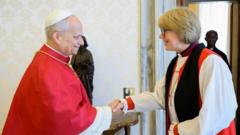
When an Archbishop stands in the heart of the Vatican to echo the Pope’s latest plea for peace, the world hears a spiritual message. The reality is far grittier. Behind the ornate marble and the echoes of Gregorian chants lies a sophisticated, often desperate diplomatic gambit intended to preserve the Holy See's relevance in a fragmenting global order. The recent cycle of anti-war statements from Pope Francis, praised loudly by his prelates, isn't just about theology. It is a calculated attempt to position the Catholic Church as the only remaining "honest broker" in a world where traditional diplomacy has largely collapsed.
However, this commitment to absolute neutrality is facing its most brutal test since the mid-20th century. For the Vatican, calling for an end to "all wars" is a safe harbor, but for the nations currently under fire, that same neutrality often feels like an abandonment.
The Mechanics of Holy See Neutrality
The Vatican operates on a diplomatic frequency that few other sovereign entities can match. It maintains the world's oldest diplomatic corps, with a presence in almost every corner of the globe. When the Pope speaks against the "madness of war," he isn't just speaking to the pews; he is speaking to a network of nuncios who are often the only western-aligned diplomats left in high-conflict zones.
This neutrality is baked into the Lateran Treaty of 1929, but the modern application is increasingly contentious. In past decades, the Church could bridge the gap between the East and West because both sides shared certain cultural or historical touchstones. That common ground has eroded. Today, the Pope’s refusal to name specific aggressors in certain conflicts is a deliberate strategy to keep channels open for prisoner exchanges and humanitarian corridors.
It is a high-stakes trade-off. By maintaining a line to every capital, the Vatican risks alienating its own flock in regions that see the conflict not as a tragedy of "both sides," but as a clear-cut case of aggression. The Archbishop’s praise for these comments serves to shield the Papacy from internal criticism, presenting a united front even as some local bishops on the ground express quiet frustration with the lack of moral clarity from Rome.
The Friction Between Faith and Realpolitik
The core tension lies in the difference between spiritual leadership and political influence. A Pope is expected to be a moral compass. An industry analyst looking at the Church as a geopolitical actor sees something else: a soft-power superpower trying to avoid being sidelined by the rise of secular nationalism.
The "anti-war" stance is frequently criticized by hardline realists who argue that pacifism, when faced with expansionist powers, is merely an invitation for further violence. The Vatican’s response is rooted in a long-term view that spans centuries, not election cycles. They have seen empires rise and fall, and their institutional memory suggests that picking a side usually ends with the Church being tied to the fate of a falling regime.
The Humanitarian Backchannel
While the headlines focus on the rhetoric, the real work happens in the shadows. The Vatican’s "secret" diplomacy often focuses on three specific areas:
- Prisoner of War Negotiations: Utilizing the local church infrastructure to verify the status of captives.
- Protection of Religious Minorities: Ensuring that conflict doesn't become a pretext for ethnic or religious cleansing.
- Grain and Resource Corridors: Using the Church’s influence in the Global South to pressure warring parties into allowing food shipments to pass.
These are the tangible results of the Pope’s "neutral" stance. If the Vatican were to issue a full-throated condemnation of one specific leader, those backchannels would likely snap shut within hours. The Archbishop’s public praise is the "public relations" layer of this deep-state religious operation, signaling to the world that the Church will not be moved from its center-point.
The Cost of Silence on the Front Lines
Every diplomatic choice has a victim. In the current global climate, the victim of Vatican neutrality is often the Church's own credibility in the eyes of the youth. In Europe and the Americas, there is a growing demand for institutions to take a stand. When the Pope speaks in generalities about "the industry of weapons," it resonates with those who are tired of the military-industrial complex, but it rings hollow for those currently hiding in basements.
The Archbishop’s recent affirmations are a necessary internal stabilizer. There is a quiet but significant rift within the College of Cardinals. Some believe the Church must return to the "Just War" theory with more vigor, while the Francis wing is pushing toward a total embrace of non-violence. This internal tug-of-war is what makes the public statements feel so choreographed. They are meant to project a sense of stability that doesn't entirely exist behind closed doors.
The Arms Trade Argument
One of the more overlooked factors in the Pope’s rhetoric is his consistent targeting of the global arms trade. This isn't just a moral stance; it’s an economic one. By framing war as a product of greed rather than ideology, the Vatican attempts to sidestep the political "team-playing" that defines modern discourse.
The Pope is essentially trying to change the subject from "Who is right?" to "Who is profiting?" This shift is clever. It allows the Church to maintain its moral authority without having to adjudicate complex territorial disputes. However, this perspective often ignores the reality that for some nations, the purchase of arms is the only thing preventing total erasure.
Historical Precedent and Future Risks
The Holy See is looking at the history books. They remember the criticisms leveled against Pius XII during World War II and the subsequent efforts to rehabilitate the Church's image through the diplomacy of Paul VI and John Paul II. The current administration believes that history will vindicate their refusal to become a "chaplain to the West."
But the world is no longer bipolar. We are entering a multi-polar era where the Vatican's traditional tools of influence—moral suasion and diplomatic recognition—carry less weight. The Archbishop can praise the Pope’s comments all he wants, but the real test will be whether those comments actually move the needle in Moscow, Beijing, or Washington.
The strategy currently relies on the hope that eventually, every warring party will get tired of fighting and need a neutral table to sit at. The Vatican is simply making sure that table is still standing when that day comes.
The risk is that by the time the parties are ready to talk, they may no longer view the Vatican as a relevant host. The rise of secular mediation firms and the involvement of regional powers like Qatar or Turkey have provided alternatives to the traditional "Vatican route." The Church is fighting for its seat at the table of global power, using the language of peace to mask a very real struggle for institutional survival.
The Archbishop’s praise isn't just a sign of agreement. It is a desperate signal to the world that the Vatican still believes it has a role to play in the management of human conflict. Whether that belief is rooted in reality or nostalgia remains the defining question of this Papacy.
The diplomatic core of the Holy See knows that once you pick a side in a global firestorm, you lose the ability to speak to the whole world. They are betting that the long-term benefit of being the world's conscience outweighs the short-term reputational damage of appearing indecisive. It is a lonely, dangerous path that leaves the Church vulnerable to charges of moral cowardice. In the eyes of the Vatican, that is a price worth paying to remain the last house on the street with its lights still on.
The next time a high-ranking cleric stands at a podium to laud the "prophetic voice" of a Pope calling for peace, look past the vestments. Look at the map. Look at the grain shipments. Look at the prisoner manifests. The "anti-war" message is the currency the Vatican uses to buy its way into rooms where it no longer has a natural right to be. It is a masterclass in soft-power survival.
Stop looking for the Church to lead a crusade; they are far more interested in surviving the one that's already started.