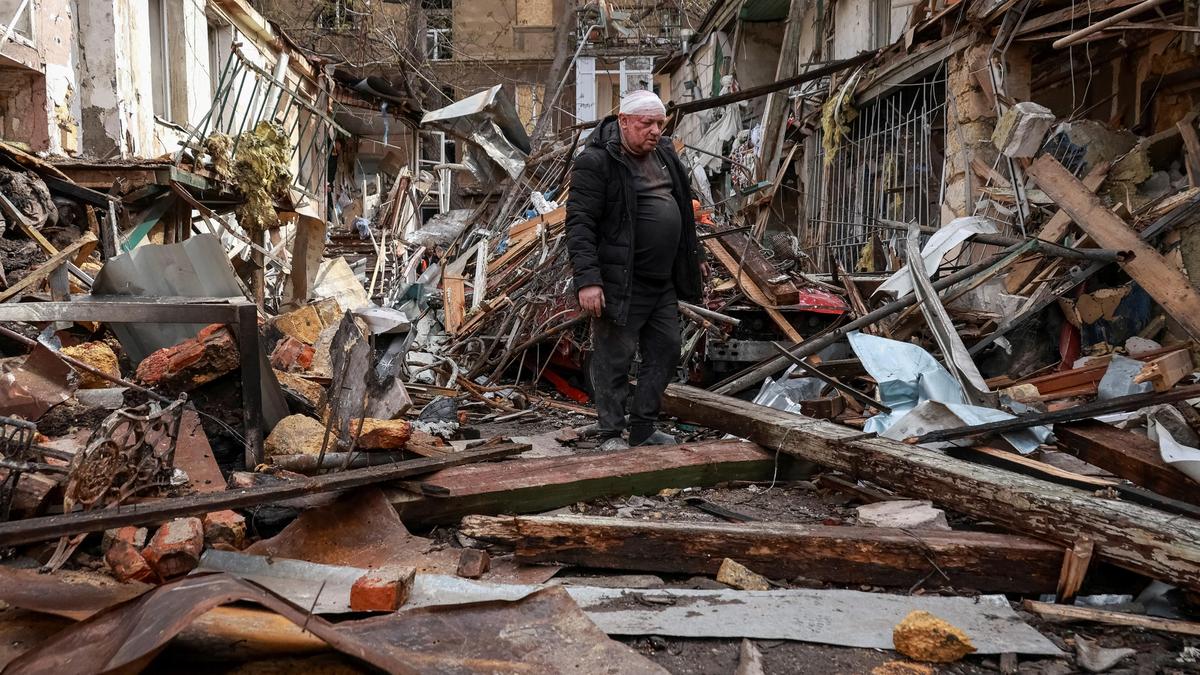
The headlines are predictable. Ten people wounded in Odesa. Residential buildings scarred. The predictable outcry over "terror tactics" follows. But while the media focuses on the humanitarian tragedy, they are completely ignoring the cold, mathematical reality of 21st-century attrition. We are watching the sunset of traditional air defense, and Odesa is the laboratory where the old world is dying.
The standard narrative suggests that every intercepted drone is a victory. It isn't. If you spend $2 million on a Patriot missile to down a $20,000 Shahed drone, you aren't winning; you are bankrupting your future. Russia isn't just trying to hit buildings; they are trying to trigger an economic collapse of the defense apparatus. When 10 people are wounded, it's a tragedy. When a city’s defense grid is bled dry of interceptors it can't replace, it’s a strategic forfeit.
The Cost Curve is a Noose
Modern warfare is no longer about who has the "best" tech. It is about who can scale the cheapest tech. The "lazy consensus" among defense analysts is that the West can simply out-produce Russia in high-end munitions. They are wrong.
The industrial base for high-altitude air defense is a legacy system built for a world that no longer exists. It relies on complex supply chains, rare earth minerals, and specialized labor that takes years to train. Conversely, the "moped" drones hitting Odesa are built with off-the-shelf components, lawnmower engines, and basic GPS modules.
Russia is playing a volume game. If they launch 50 drones and 45 are shot down, the media reports a "successful defense." In reality, those 45 successful intercepts cost the defender a fortune in non-renewable assets, while the five that hit their mark provide the psychological and structural damage Russia seeks.
Stop Treating Drones Like Missiles
The biggest mistake in the current Odesa reporting is the classification of these attacks. A drone is not a missile. A missile is a high-speed, high-cost kinetic tool. A drone is "loitering ammunition." It is essentially a flying IED.
When officials talk about "defending Odesa," they are still thinking in terms of Iron Domes and missile batteries. This is flawed. You don't use a scalpel to kill a swarm of mosquitoes. You use a net or a bug zapper.
The obsession with "intercept rates" is a vanity metric. If a drone forces a billion-dollar radar system to reveal its position, the drone has already won before it even explodes. We are seeing the systematic mapping of Ukraine’s electronic signature. Every night in Odesa is a data-harvesting mission for the Kremlin. They are testing response times, identifying blind spots in the radar coverage created by the city's unique coastal geography, and measuring the fatigue of the crews.
The Geography of Failure
Odesa is a nightmare to defend for reasons the "experts" rarely mention. The Black Sea is not just a scenic backdrop; it is a thermal and acoustic highway for low-flying drones.
- Radar Clutter: Low-altitude drones flying over water are notoriously difficult to track because of "sea clutter"—the radar reflections off waves.
- Acoustic Masking: The sound of the surf can mask the distinct lawnmower drone of a Shahed until it is virtually on top of the target.
- The Vector Problem: Attacks can come from a 180-degree arc off the coast, forcing defenses to be spread thin rather than concentrated on a known frontline.
By the time an alert sounds in Odesa, the drone has likely been in Ukrainian airspace for less than three minutes if it launched from a nearby platform or crossed the sea at a low altitude. The civilian casualties aren't just collateral damage; they are the result of a defensive system being forced to make impossible choices in milliseconds.
The Myth of the "Safe City"
Western leaders keep promising to make Ukrainian cities "safe." This is a lie, and a dangerous one. In a drone-saturated environment, there is no such thing as a 100% intercept rate. Even if you hit 99%, the debris from the intercept falls on residential blocks.
Many of the injuries in Odesa aren't from the drone's warhead, but from the falling shrapnel of the "successful" intercept. This is the nuance the news skips: the act of defending a city often contributes to its destruction.
We need to stop asking "How many drones did we shoot down?" and start asking "How do we make the drones irrelevant?"
The Pivot to Kinetic Denial
The only way to win the battle for Odesa—and by extension, the war of attrition—is to move away from expensive missiles and toward kinetic denial and electronic warfare (EW).
We’ve seen a rise in "Anti-Drone Mobile Groups"—pickups with heavy machine guns and searchlights. This is the "ugly" solution that actually works. It's cheap, it's scalable, and it uses ammunition that costs pennies compared to the drone it’s targeting.
However, the real frontier is EW. If you can’t jam the drone, you aren’t defending the city; you’re just participating in a very expensive firework show. The problem is that Odesa is a dense urban environment. High-powered jamming interferes with civilian infrastructure, emergency services, and communications. Russia knows this. They use the city's own complexity against it.
The Logistics of the Aggressor
Let’s dismantle the idea that Russia is "running out" of drones. They have transitioned to a wartime economy. They are not buying these from Iran anymore; they are manufacturing them in massive facilities in Tatarstan.
While the West debates whether to send another battery of aging Hawks or an additional Patriot, Russia is streamlining a production line that views these drones as disposable as a rifle round.
If you want to understand why Odesa keeps getting hit, look at the supply chain. The components are smuggled through third-party nations, hidden in plain sight as "agricultural technology." Sanctions have failed to stop the flow of microchips because the microchips needed for a Shahed are the same ones in your microwave or your child's remote-control car.
The Brutal Reality of "Interception"
People see a video of an explosion in the sky over Odesa and cheer. I see a failure of strategy.
Every explosion in the sky is a loud announcement that the enemy reached your doorstep. True defense happens 500 miles away, at the launch site, at the factory, and in the digital code that guides the bird.
We are currently treating the symptom (the drone over Odesa) and ignoring the disease (the mass-production of cheap, autonomous violence).
Why Conventional Wisdom is Failing:
- Metric Displacement: Success is measured by "lives saved today" rather than "strategic assets preserved for tomorrow."
- Technological Arrogance: Assuming a more expensive sensor will always beat a cheaper seeker.
- Static Thinking: Using fixed defense positions against a highly mobile, unpredictable swarm.
Redefining the Counter-Attack
If you want to stop the wounding of civilians in Odesa, you don't build a bigger wall. You change the economics of the attack.
Imagine a scenario where the cost of a drone launch exceeds the potential damage it can cause. This only happens when the defender utilizes autonomous interceptor drones—small, cheap "hunter-killers" that collide with the incoming threat. This removes the million-dollar missile from the equation. It levels the financial playing field.
Until we move to autonomous, low-cost, high-volume defense, Odesa will continue to bleed. Russia isn't stupid. They aren't "desperate." They are calculating. They are betting that the West will tire of the bill before they tire of the slaughter.
The wounds in Odesa are a reminder that in the age of the drone, the fortress is a fantasy. You don't defend a city by standing under an umbrella of missiles; you defend it by making the umbrella as cheap and disposable as the rain.
Stop celebrating the intercepts. Start obsessing over the cost-per-kill. If the math doesn't change, the outcome won't either.
Deploy the jammers. Scale the mobile gun trucks. Abandon the reliance on prestige weaponry.
Odesa isn't a target of "terror." It's a target of depletion. Start acting like it.