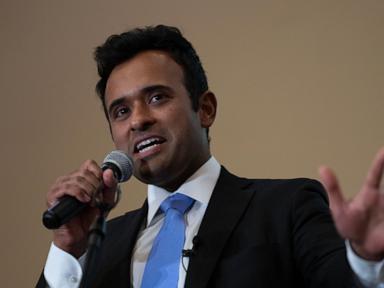
The air in Ohio during a primary cycle usually tastes like iron and wet asphalt. It is the scent of a machine grinding into gear. In the spring of 2024, that machine didn't just hum; it screamed. But for Vivek Ramaswamy, a man who built a political identity on being the loudest voice in the room, the results from the Republican gubernatorial primary echoed with a much quieter, more unsettling frequency.
To understand the stakes, you have to look past the spreadsheets and the cable news chyrons. You have to look at the voter who walks into a high school gymnasium in a town like Findlay or Zanesville. This voter isn't a data point. They are tired. They have watched decades of factory closures, the opioid crisis, and the slow erosion of the middle class. When they stand behind that curtain, they aren't looking for a venture capitalist’s five-point plan for "anti-woke" reform. They are looking for someone who feels like home.
Vivek Ramaswamy represents the future of a certain kind of Republicanism—fast, intellectual, unapologetic, and digital. But the Ohio primary served as a stark reminder that the future still has to answer to the present.
The Mirror and the Ballot Box
The race for the GOP nomination for governor wasn't officially about Ramaswamy. Yet, his fingerprints were everywhere. He threw his weight, his brand, and his rhetoric behind candidates who mirrored his "America First" 2.0 energy. He bet big on the idea that the grassroots were ready to bypass the traditional institutional gatekeepers in favor of a more aggressive, populist edge.
The bet failed.
It didn't just lose; it sputtered. The candidates most closely aligned with the Ramaswamy doctrine found themselves hitting a ceiling. It was a glass ceiling made of Midwestern pragmatism. While the national headlines focus on the firebrands, the actual ballots were cast for names that felt steady. Boring, even.
Consider a hypothetical voter named Sarah. Sarah lives in a suburb of Columbus. She voted for Donald Trump twice. She likes the idea of a fighter. But when she looks at her local government, she wants to know if the snow is going to be cleared and if the schools are going to stay out of the national culture war crosshairs so her kids can just learn math. When she hears Ramaswamy’s high-speed delivery about ESG scores and the administrative state, she doesn't disagree. She just doesn't feel it. It sounds like a podcast. Sarah doesn't live in a podcast. She lives in a house with a rising mortgage and a leaky roof.
The Friction of the Road
Ramaswamy’s struggle in Ohio highlights a fundamental tension in modern politics: the gap between digital dominance and physical presence.
On X, formerly Twitter, Ramaswamy is a titan. His clips go viral. His debates are masterclasses in rhetorical agility. He can dismantle a reporter’s premise in thirty seconds flat. But the voters who decide gubernatorial primaries in the Midwest don't live on X. They live in physical communities where the "establishment" isn't a dirty word—it’s the guy who runs the local insurance agency or the woman who chaired the school board for twenty years.
The "headwinds" mentioned by analysts are actually just the friction of the real world.
The primary results suggested that while the MAGA base remains the dominant force in the party, there is a distinct preference for how that power is wielded. There is a "Trump style" that is raw and visceral, and then there is the "Ramaswamy style" which is polished and intellectualized. Ohio signaled that the latter might be too clever by half for the very people it claims to represent. It’s the difference between a steak and a deconstructed beef bourguignon. Both are meat, but one feels like a meal and the other feels like an experiment.
The Invisible Stakes of 2024
Why does this matter for the fall? If Ramaswamy intends to be a kingmaker—or eventually, a king—he has to solve the Ohio Problem.
The problem is one of soul, not just strategy. The Republican party is currently a coalition of the disaffected. You have the rural working class, the suburban skeptics, and the young, tech-adjacent "New Right." Ramaswamy speaks perfectly to the third group. He speaks passably to the second. But he is struggling to bridge the gap to the first.
The rural voter in Ohio is deeply suspicious of anyone who looks like they’ve never had dirt under their fingernails. It’s a primal, almost tribal suspicion. When Ramaswamy talks about the "shadow government," it sounds like a conspiracy theory to some and a reality to others. But when he talks about it in a $3,000 suit with the cadence of a McKinsey consultant, it loses its punch. It feels like an outsider trying to explain the insider's game.
The primary results were a cold bucket of water. They showed that the MAGA movement is not a monolith that can be inherited by anyone who uses the right keywords. It is a deeply personal connection between a specific leader and a specific audience. You cannot simply download the software of populism and run it on different hardware.
The Language of the Unheard
There is a specific kind of silence that follows a political defeat in the heartland. It isn’t the silence of apathy. It’s the silence of a people waiting for a different frequency.
Ramaswamy is a man of a thousand answers. He has a solution for the Department of Education, a plan for the border, and a thesis on the decline of American excellence. But politics, at its core, is not about having the best answers. It is about asking the right questions in a way that makes the listener feel like they are finally being heard.
In the Ohio primary, the candidates who won were those who spoke the language of the local. They talked about the state’s economy, the specific challenges of the Great Lakes region, and the familiar rhythms of Ohio life. They didn't try to turn every local election into a referendum on the global order.
The lesson for the fall campaign is clear: Nationalizing every local grievance works for building a brand, but it falters when it comes to building a mandate.
Imagine a town hall in a small Ohio village. The lights are humming. The coffee in the back is burnt. A man in a flannel shirt stands up and asks about the closing of a nearby clinic. If the answer involves a twenty-minute monologue on the "managerial class" and the "unconstitutional Fourth Branch of government," the man will sit down. He might even nod. But he won't feel helped. He will feel like he just watched a very impressive performance.
The Road Ahead is Not a Screen
Ramaswamy is now looking toward the fall, and beyond that, a future where he is a central pillar of the American Right. To get there, he has to learn how to slow down.
The pace of the digital world is instantaneous. The pace of the physical world—especially in the Midwest—is slow. It is the pace of the seasons, the pace of a crop growing, the pace of a neighborhood slowly changing over decades. If Ramaswamy wants to lead these people, he has to prove he can inhabit their pace.
He needs to show that he isn't just using Ohio as a laboratory for his ideas, but that he actually cares about the lab itself.
The primary was a warning shot. It told the "New Right" that the "Old Guard" and the "Quiet Middle" still hold the keys to the kingdom. You can scream at the gates all you want, but eventually, you have to convince the person holding the keys to let you in. And that person usually doesn't care how many followers you have on social media. They care if they can trust you when the lights go out.
The Ohio GOP primary wasn't a rejection of the "America First" agenda. Far from it. It was a rejection of the idea that the agenda can be delivered via a high-speed data transfer. It requires a human touch. It requires the ability to stand in the rain at a county fair and talk about nothing for three hours just to prove you’re willing to be there.
As the leaves begin to turn and the heat of the primary fades into the high-stakes chill of the general election, the silence in the heartland remains. It is a waiting silence. It is the sound of a million people watching, listening, and wondering if anyone actually knows the way home, or if they’re all just reading from a script written in a high-rise far, far away.
The man who finds the right frequency for that silence won't just win a primary. He will win the country. But for now, the frequency remains elusive, lost somewhere in the static between the screen and the street.
The machine is still grinding. The iron is still in the air. And the voters are still standing behind the curtain, waiting for a voice that sounds like their own.