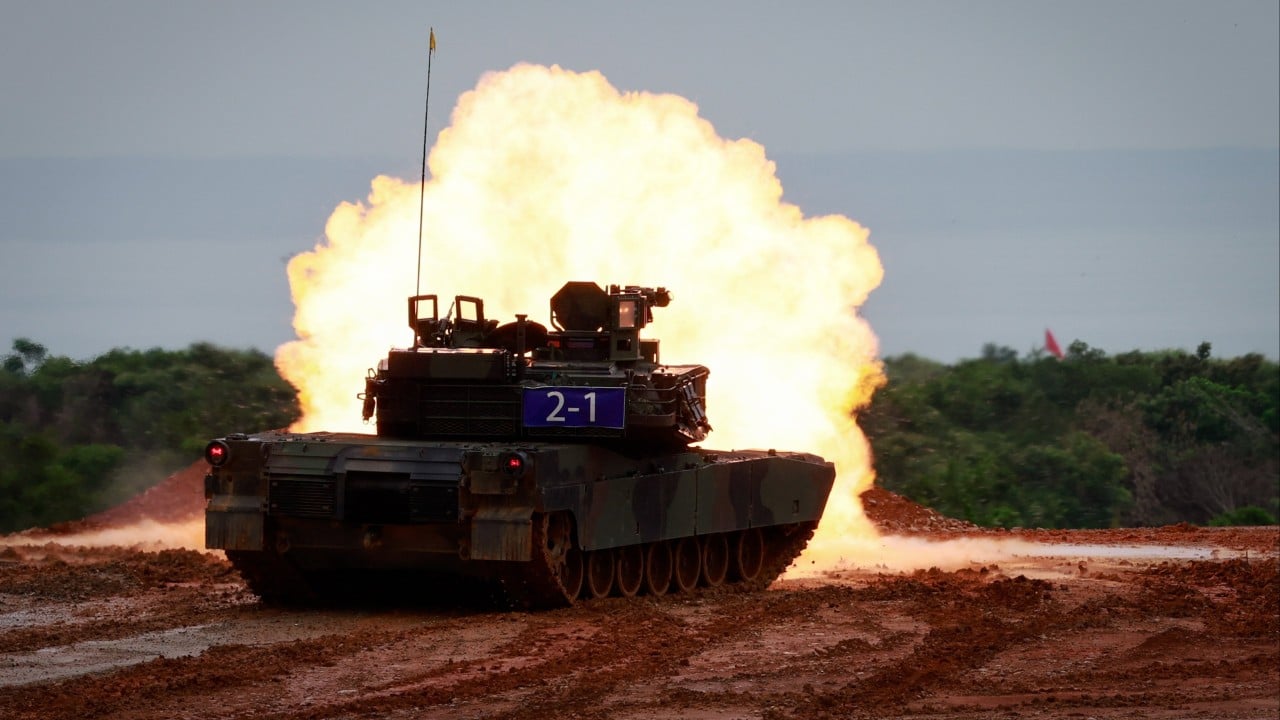
The air at the Port of Keelung carries a specific weight—a mixture of salt spray, diesel fumes, and the electric tension of a nation that has spent decades looking toward the horizon. For the dockworkers watching the heavy ramps of the transport ship lower, this isn't just another shipment of industrial machinery. It is the arrival of the M1A2T Abrams.
The first time you see one of these machines up close, you don't think about geopolitics. You think about mass.
Seventy tons of depleted uranium armor and steel do not move like a car; they displace the very atmosphere around them. As the final batch of these American-made behemoths rolls onto Taiwanese soil, completing a years-long delivery process, the island’s defense strategy shifts from the theoretical to the tangible. This is the end of a deal, but the beginning of a new, much heavier reality.
The Ghost in the Rice Paddies
To understand why a small, mountainous island needs a fleet of the world’s most advanced main battle tanks, you have to look past the high-tech sensors and the 120mm smoothbore cannons. You have to look at the mud.
For years, critics argued that heavy armor was a relic of the past, a dinosaur in an age of drones and precision missiles. They envisioned a "porcupine" defense, where Taiwan would rely solely on small, mobile anti-ship missiles and sea mines. But military planners in Taipei know a secret that history has proven time and again: you cannot hold ground with a drone.
Consider a hypothetical scenario. It is a humid Tuesday morning. The beaches of western Taiwan, normally quiet save for the sound of the surf, are suddenly alive with the roar of amphibious engines. If an adversary manages to get boots on the ground, the math of survival changes instantly. A soldier with a shoulder-fired missile is a threat, but a soldier behind seventy tons of impenetrable armor is an obstacle that cannot be ignored.
The Abrams is the ultimate insurance policy. It is designed to be the "hard kill" capability that stops an invasion at the water's edge. By finishing this shipment, Taiwan has signaled that the cost of entry has just become prohibitively expensive.
A Language of Kinetic Force
There is a psychological component to these machines that rarely makes it into the dry reports of defense analysts. When a crew climbs into an M1A2T, they aren't just operating a vehicle. They are participating in a decades-old partnership.
These tanks are the "T" variant—customized specifically for the unique terrain of the island. They feature upgraded suspension systems to handle the rugged coastal roads and advanced communication arrays that allow them to talk to the rest of the fleet in real-time. But more than the hardware, the Abrams represents a shared language of defense between Taipei and Washington.
Every shell loaded into the rack and every hour spent training in the heat of the Hsinchu highlands reinforces a specific message: the status quo is guarded by steel.
The logistics of this delivery were a Herculean feat. Moving dozens of tanks across the Pacific, navigating the political minefields of international diplomacy, and ensuring the infrastructure was ready to receive them required a level of coordination that borders on the obsessive. It wasn't just about shipping boxes. It was about building the specialized maintenance facilities, training the mechanics who will keep these beasts breathing, and redesigning bridges to ensure they don't collapse under the weight of a sudden armored surge.
The Sound of Seventy Tons
If you stand near the engine of an Abrams, you don't hear a piston-driven rumble. You hear the high-pitched whine of a Honeywell AGT1500 gas turbine engine. It sounds like a jet plane idling on a runway.
That sound is now a permanent fixture of the Taiwanese landscape.
While the world watches satellite feeds and parses the rhetoric of world leaders, the actual work of defense happens in the grease-stained hangars where Taiwanese tankers are learning the intricacies of the Abrams' fire control system. They are learning how to hit a target three miles away while moving at forty miles per hour.
This isn't about aggression. It is about the visceral, human desire to protect a home.
For the young lieutenant who will command one of these tanks, the "US tank deal" isn't a headline or a line item in a budget. It is the smell of the interior—the scent of electronics and hydraulic fluid. It is the weight of the hatch as he swings it shut, sealing himself into a pressurized world of green-glow screens and thermal optics. In that moment, the abstract concept of "national security" becomes a very narrow, very intense focus on the road ahead.
Beyond the Horizon
The completion of this shipment marks a closing chapter in a specific era of procurement. But the story of the Taiwan Strait is never truly finished. It is a narrative of constant adaptation.
As these tanks are integrated into the 6th Army Corps, they don't just sit in garages. They become part of an ecosystem. They work in tandem with the "Clouded Leopard" wheeled armored vehicles and the Apache attack helicopters hovering above the treeline. This combined-arms approach is what makes the Abrams so lethal. It isn't a lone wolf; it is the centerpiece of a sophisticated, interlocking grid of defiance.
There are those who will say that tanks are obsolete in the face of modern electronic warfare. They will point to grainy footage of armored columns being picked apart in other conflicts. But they forget that those failures were often the result of poor training and a lack of support. Taiwan has spent years preparing for this specific arrival, ensuring that their tankers are not just drivers, but masters of a complex, digital battlefield.
The stakes are invisible until they aren't. They are hidden in the quiet calculations of a general across the water, weighing the odds of a successful landing against the reality of an Abrams waiting in the treeline.
As the sun sets over the harbor, the last of the tanks is secured onto a heavy-duty transporter. The port returns to its usual rhythm of commerce and shipping. But the ground feels different now. It feels firmer. It feels like it belongs to those who are willing to defend it with the heaviest tools humanity has ever built.
The steel has arrived. The line is drawn. And in the silence that follows the roar of the turbine engines, there is a new, unmistakable weight to the peace.